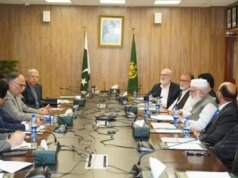








PESHAWAR – Governor Khyber Pakhtunkhwa Faisal Karim Kundi on Monday said sustainable peace was essential for the province’s economic development, investment and job creation, stressing that province possessed abundant natural resources but continued to face security and economic challenges.
He expressed these views during an interactive session with a 104-member delegation of the 20th National Workshop Balochistan, led by Brig Bilal Ghafoor, at the Governor House. The delegation comprised students, journalists, youth and representatives from different walks of life belonging to all four provinces, Azad Jammu and Kashmir and Gilgit-Baltistan.
Responding to questions on security, terrorism, constitutional affairs, inter-provincial relations and the country’s political situation, the Governor said Khyber Pakhtunkhwa had historically served as a major trade hub with Central Asia but had also borne the brunt of terrorism due to its border with Afghanistan. He said terrorism remained a major challenge in both Balochistan and Khyber Pakhtunkhwa, adding that effective coordination through regular meetings of the provincial Apex Committee was necessary to tackle the issue.
The Governor said Rs900 billion had been provided by the federal government for the war against terrorism, but questions remained over its utilization. He added that despite immense sacrifices, the KP Police still lacked modern equipment and bulletproof vehicles, and said he had recommended to the Chief Minister that police salaries be brought at par with those of other provinces.
Kundi said the annual financial commitment made at the time of the merger of the erstwhile FATA had not been fully honoured even after nine years. He also expressed concern over the imposition of sales tax in the merged districts and PATA, saying taxes should only be imposed after providing those areas with development and public services comparable to the rest of the country. He reaffirmed support for all measures aimed at protecting the province’s rights and public interests, including the provincial government’s stance on the issue.
The Governor also called for the announcement of a new National Finance Commission (NFC) Award, saying that the seventh NFC Award had been finalized in 2010 and no new award had since been announced. He urged that meetings of the Council of Common Interests (CCI) be held every 90 days in accordance with the Constitution.
The Governor said the annual allocation of Rs4 billion for 36 public sector universities in the province was insufficient even to meet salary expenditures. He said Khyber Pakhtunkhwa had immense talent, particularly in sports, and assured that the Governor House would remain open for youth, students, athletes and investors.
Governor proposes to set up KPPSC regional offices
in remote areas
Governor Khyber Pakhtunkhwa Faisal Karim Kundi has written to Chief Minister Sohail Afridi, proposing the establishment of regional offices of the Khyber Pakhtunkhwa Public Service Commission (KPPSC) in Dera Ismail Khan, Malakand and Abbottabad to improve access to recruitment services for candidates from remote parts of the province.
In his letter, the Governor said the KPPSC currently operates only from its headquarters in Peshawar, forcing candidates from southern districts, Malakand, Hazara and other far-flung areas to travel long distances for written examinations, interviews and other recruitment processes.
He said the proposed regional offices would reduce travel and accommodation costs, particularly for women and candidates from remote areas, while ensuring equal access to public sector employment opportunities across the province.
The Governor suggested that the project could be implemented in phases by utilizing existing government buildings and infrastructure with minimum financial burden. He said the initiative would improve access to KPPSC services, strengthen transparency and merit-based recruitment, promote equal representation from all regions of the province and bring public services closer to the people.
Kundi also referred to the successful regional office models of the Punjab and Sindh public service commissions, saying similar facilities in Khyber Pakhtunkhwa would greatly benefit job seekers across the province.