






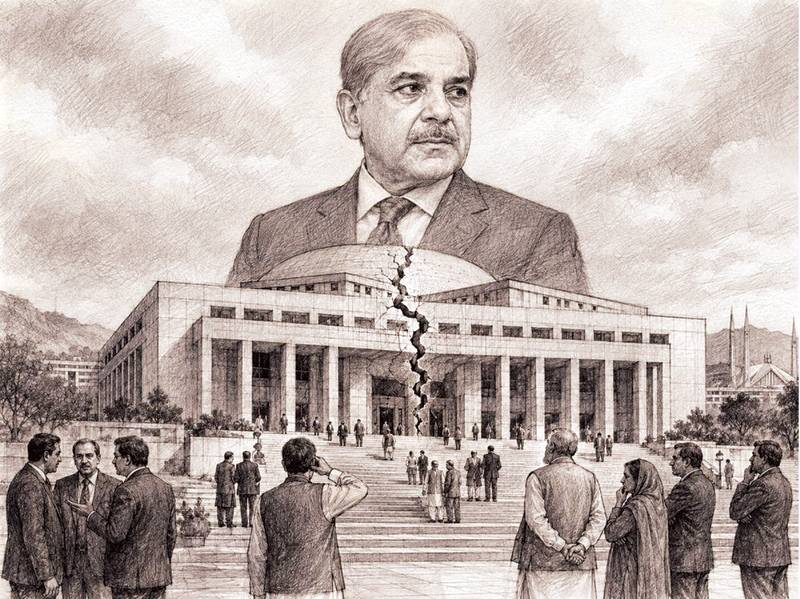

Prime Minister Shehbaz Sharif faces no immediate threat to his survival in office. But the political mood around his government has begun to change. The criticism now goes beyond performance. Doubts are growing about whether the present setup can deliver at all.
Interior Minister Mohsin Naqvi said recently that the system had effectively collapsed and could no longer deliver. His remarks were striking not because opposition politicians have not said similar things before, but because Naqvi sits at the heart of the current setup.
Sohail Warraich has pushed the argument further.
In a recent vlog with journalist Mansoor Ali Khan, Warraich, the veteran political commentator, argued that Shehbaz had failed to build a political narrative and had traded politics for proximity to the powers that be. In his Jang column, he delivered a sharper indictment, pointing out that Shehbaz has spent the better part of two decades at the top of government, first in Punjab and now twice as prime minister, while the basic questions of governance and delivery remain unresolved.
That critique cuts unusually deep because delivery has always been Shehbaz’s main political claim.
He has never possessed Nawaz Sharif’s political symbolism or Imran Khan’s populist appeal. His case has always been managerial. Long meetings. Tight monitoring. Infrastructure. Administration. Getting things done.
If that diagnosis gains ground, Shehbaz becomes particularly vulnerable to the obvious question.
If the machinery has broken down, who has been running it?
That question is becoming more potent as calls for new provinces, smaller administrative units and stronger local governments gain momentum.
Real decentralization means moving money and political authority away from provincial capitals. That immediately threatens the interests of chief ministers, provincial governments and legislators who have spent decades building political influence around control over development spending.
Strong local governments require money. Provinces are already under fiscal pressure. If meaningful financial authority is shifted to districts, cities and municipalities, somebody higher up the political chain has to surrender it.
That is also why meaningful devolution has been repeatedly promised since 2008 but rarely allowed to threaten the authority of provincial governments.
Pakistan’s elected system makes that far harder than it was under Pervez Musharraf.
Musharraf could push substantial powers downward because, when his devolution project began, there were no elected national and provincial assemblies competing for money and authority. He governed through a military-led federal structure, governors and technocratic administrations. That political luxury no longer exists.
Today, MNAs and MPAs face constant pressure to deliver roads, drainage, jobs, electricity schemes and other constituency favors. Strip away their development budgets and empower mayors and district governments instead, and a large part of the patronage system on which parliamentary politics operates begins to unravel.
For PML-N, that problem is especially acute.
Its lawmakers in Punjab are already defending seats against a PTI vote that has not receded. Many of them depend on access to provincial government resources to retain influence in their constituencies. A strong local government structure would weaken that relationship and reduce the advantages of holding power in Lahore.
PTI remains constrained institutionally, but the political conversation has begun moving into territory favorable to it. Every public declaration that the existing system has failed gives the party fresh material for its argument that the post-2024 political arrangement lacks legitimacy and popular support.
The greater the debate becomes about redesigning the system, rather than simply improving the government’s performance, the easier it becomes for PTI to argue that the present political order has exhausted itself.
For PPP, however, the same reform debate may be even more threatening.
Bilawal Bhutto-Zardari’s recent warning that the political “tick tock” had begun came amid tensions with PML-N and cannot simply be read as evidence that PPP is preparing to topple Shehbaz. But it reflects a broader shift.
PPP can see the governing arrangement becoming less settled. It also knows that some of the structural changes now being discussed could threaten its own political foundations.
Any serious discussion of new provinces, administrative divisions or powerful metropolitan governments collides with the party’s traditional control over Sindh. Karachi has always presented PPP with a peculiar political problem. It governs the province, but its electoral hold over Pakistan’s largest city has historically been far weaker than its dominance in rural Sindh.
A genuinely empowered Karachi government, particularly one with substantial fiscal autonomy, would weaken the provincial government’s control over the city. More radical proposals to redraw administrative boundaries or create new provinces would go further still, raising questions that strike at the foundations of PPP’s political power.
That gives the party two competing incentives. It wants to distance itself from PML-N’s political liabilities while making sure that any redesign of the system does not erode its own control over Sindh.
None of this means Shehbaz is about to lose office. But political trouble begins well before a no-confidence vote, when allies start hedging, old assumptions come under question and previously disruptive ideas acquire powerful sponsors.
The people now declaring that the system has broken down are the people running it.