






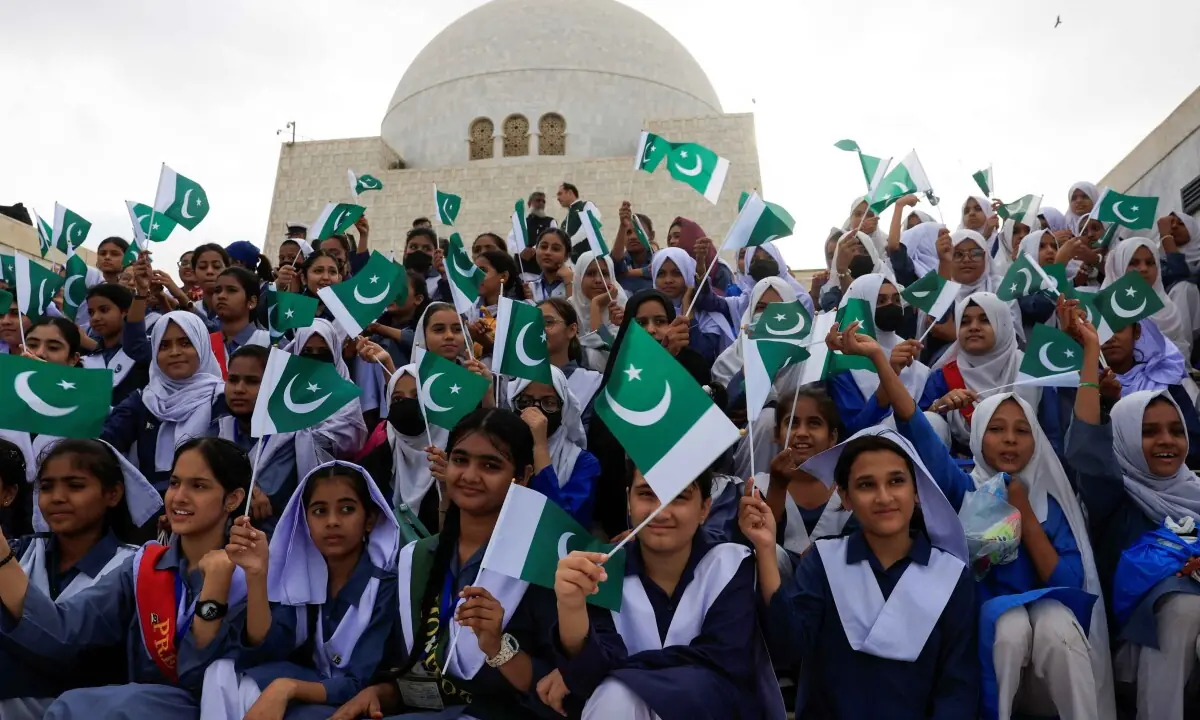
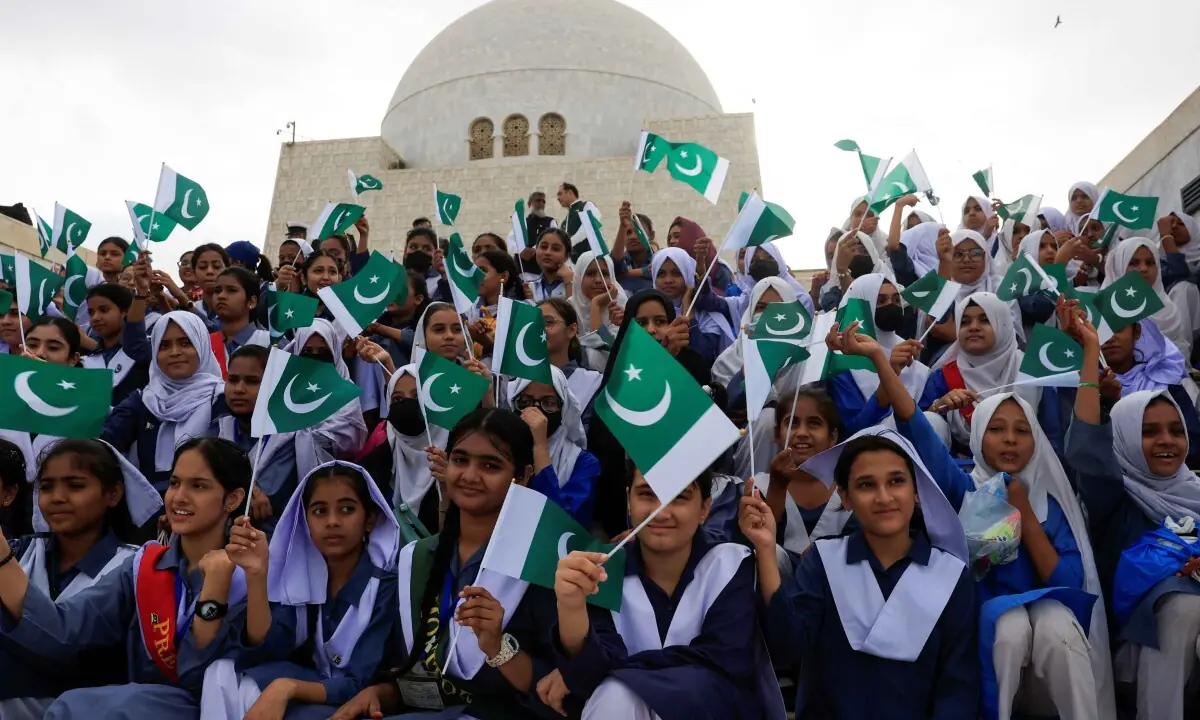
Pakistan’s civilian and military leadership has stressed the need for unity and reforms as the nation celebrates 79 years of independence today.
According to state-run Radio Pakistan, the day dawned with a 31-gun salute in Islamabad and a 21-gun salute at the provincial headquarters. A change of guards ceremony was also held at the mausoleum of Quaid-i-Azam Muhammad Ali Jinnah in Karachi.
Flag hoisting ceremonies were also held at the Supreme Court and the Federal Constitutional Court in Islamabad.
‘Pakistan’s security linked to peace in our neighbourhood’
In his message, President Asif Ali Zardari paid tribute to Quaid-i-Azam, those behind the Pakistan Movement and those who sacrificed their homes, security and livelihoods in the struggle for a homeland.
“But independence is not only a historic achievement. It is also a responsibility that each generation must carry forward. The Pakistan that was created through the democratic will of its people must continue to grow stronger, more secure and more prosperous. Our task is not only to remember what earlier generations achieved, but to add to it through our own work,” he said.
The president said that the past year had reminded citizens of the strength of the Pakistani nation.
Recalling last year’s brief military conflict with India, he said, “The events surrounding Marka-i-Haq demonstrated that Pakistan seeks peace, but also possesses the resolve and capacity to defend its sovereignty and national interests. The lesson of strength is ultimately a lesson of responsibility. A country that can defend itself must also use its strength to prevent conflict, protect peace and serve the interests of its people.”
He said that the security and stability enjoyed today had come at a great cost, paying tribute to the martyrs of the armed forces, law enforcement agencies and police.
“Their courage and commitment have helped safeguard our nation against external aggression and the threat of terrorism. The people of Pakistan remain deeply grateful for their service,” he said.
He also highlighted Pakistan’s efforts to facilitate dialogue in the region.
“Pakistan has effectively used its channels of communication, its geographical location and diplomatic capital to encourage dialogue and de-escalation at a time when wider conflict could have serious consequences for the region and the world,” he said.
He reiterated that all disputes must be ultimately addressed through dialogue and diplomacy.
“Our security is linked to the peace and stability of our neighbourhood and the world at large. Pakistan will continue to support efforts that reduce tensions, protect regional stability and create conditions for cooperation,” he said.
The president also went on to say that the country must focus on the work that will determine Pakistan’s future.
“We must strengthen our economy, create greater opportunities for our young people, improve education and skills, strengthen institutions through a series of governance, economic and social reforms to ensure that the benefits of development and democracy reach every part and community of the country,” he said.
“Pakistan’s greatest strength is its young people. Across the country and around the world, they are demonstrating their talent in science, technology, business, education and the creative industries. Our responsibility is to give them the education, skills and opportunities they need to realise their potential. By investing in our youth today, we are investing in Pakistan’s future,” he added.
“For ordinary Pakistanis, national progress is measured in practical terms. It means a young person finding the skills and opportunity to build a career. It means a family being able to access quality education and healthcare. It means farmers, workers, traders and businesses being able to plan for the future with greater confidence. The strength of Pakistan will ultimately be judged by whether our national progress improves the lives of its people,” President Zardari said.
He also voiced Pakistan’s support for the people of occupied Kashmir, saying Pakistan will continue to support a peaceful resolution of the dispute in accordance with the aspirations of its people and the relevant United Nations resolutions.
On Afghanistan, the president said that Pakistan had always respected and supported the national sovereignty of our neighbour Afghanistan and expected the same reciprocity.
“It is sad that the current interim regime of Afghanistan is allowing and supporting a cocktail of terror groups to use their soil for launching attacks against neighbouring countries including Pakistan. It is sad the Taliban regime of Afghanistan is collaborating with India in launching terror attacks against Pakistani civilians and security personnel. They are doing this to distract us from the peace building efforts of Pakistan, recognised by the entire world,” he said.
“I warn them to stop these evil actions against the people of Pakistan and assure all and sundry that the armed forces of Pakistan are capable of defeating these evil designs,” he said.
He ended his message by calling on the nation to contribute to the country’s progress in whatever field they serve.
‘Pakistan committed to defending its national interests’
Prime Minister Shehbaz Sharif also began his message by paying tribute to the founding leaders of Pakistan, saying the nation owed the fulfilment of its dream of an independent homeland to their vision, statesmanship and sacrifices.
Highlighting the government’s economic achievements over the past two-and-a-half years, PM Shehbaz said the country had successfully navigated challenging circumstances to achieve economic stability and was now moving towards becoming a developed economy.
He noted that remittances from overseas Pakistanis had increased by $11.3 billion over the past two years, which he termed a reflection of their confidence in government policies.
The prime minister said harnessing modern information technology, promoting innovation-driven industrial and agricultural development, creating employment opportunities and establishing a world-class education and skills system remained among the government’s top priorities.
Paying tribute to the armed forces, the prime minister said the military, under the leadership of Chief of Defence Forces (CDF) and Chief of Army Staff Field Marshal Syed Asim Munir, had demonstrated exemplary unity and courage during Marka-i-Haq, adding another chapter to the country’s history of defence.
He said Pakistan remained committed to defending its national interests, including its right to water resources, and reiterated that the country would continue to play its role as a responsible nation and a stabilising force for regional and global peace.
He cited the Makkah Joint Defence Agreement between Pakistan, Saudi Arabia and Turkiye as testimony to the country’s growing strategic role in the region.
The prime minister also expressed solidarity with the people of occupied Kashmir and the Palestinian people. He said lasting peace in South Asia was contingent upon a diplomatic resolution of the Kashmir dispute in line with United Nations resolutions, international law and the aspirations of the Kashmiri people.
The prime minister also paid tribute to the martyrs of the armed forces and law enforcement agencies who sacrificed their lives for the country, and called upon all segments of society, particularly political parties, to work together for national unity, integrity and the advancement of national interests.
He concluded his message by praying for Pakistan’s continued progress and dignity in the comity of nations.
‘Pakistan’s strength lies in the unity of its people’
CDF Munir, Chief of Naval Staff Admiral Naveed Ashraf and Chief of Air Staff Air Chief Marshal Zaheer Ahmed Baber Sidhu also issued a message to mark Independence Day.
According to Inter-Services Public Relations (ISPR), the armed forces paid tribute to the Quaid and those whose sacrifices resulted in a sovereign Pakistan.
“Their vision, courage and resolve remain a guiding force for the nation and continue to inspire us to uphold the principles and ideals of Pakistan,” the statement said.
“The armed forces of Pakistan respectfully acknowledge the supreme sacrifices of our martyrs, the services of our veterans, the dedication of law enforcement personnel and the contributions of every Pakistani who has served the nation. Their courage and selfless service have bolstered Pakistan’s resilience and safeguarded its independence, security and national interests,” it added.
“As guardians of Pakistan’s sovereignty and territorial integrity, the armed forces reaffirm their unwavering resolve to defend the motherland against all threats, uphold the Constitution and discharge the sacred trust reposed in them by the people of Pakistan. United with the nation, the armed forces will remain steadfast in preserving peace and stability while creating an environment conducive to national progress and prosperity,” the statement said.
“Pakistan’s strength lies in the unity and collective resolve of its people. On this Independence Day, let us renew our commitment to the enduring principles of faith, unity and discipline, strengthen national cohesion, promote tolerance and work together towards a secure, stable and prosperous Pakistan,” it concluded.
Dar reaffirms determination to safeguard country’s sovereignty
In his message on the occasion, Deputy Prime Minister and Foreign Minister Ishaq Dar recalled Marka-i-Haq and reaffirmed Pakistan’s determination to safeguard its sovereignty and territorial integrity.
“We commemorated the first anniversary of Marka-i-Haq, recalling Pakistan’s resolute and successful response to Indian aggression in 2025,” he said in a televised address to the nation.
“The occasion reaffirmed our determination to safeguard Pakistan’s sovereignty, security and territorial integrity while remaining firmly committed to international law, responsible state craft and the pursuit of regional peace.”
At the outset of his address, the deputy PM extended greetings to Pakistanis and expatriates on the Independence Day, saying we commemorate the day “to pay tribute to Quaid-i-Azam whose visionary leadership, unwavering resolve and steadfast commitment transformed the aspirations for a separate homeland into reality”.
He also paid honour to the leaders and workers of the Pakistan movement whose “courage, dedication and countless sacrifices laid the foundations of our independent state”.
Dar said that since independence, the country had made “remarkable strides across diverse fields guided by the enduring principles of unity, faith and discipline”.
“Today we are a resilient nation of more than 250 million people bound together by our shared history, collective heritage and common aspirations,” he added.
He also noted that the country’s achievements in education, science and technology, economic development, sports, culture and other fields “reflect the talent, determination and immense potential of our people”.
The deputy PM also mentioned Pakistan’s “strengthened” position on the international stage over the past eight decades.
“Our expanding diplomatic engagement, growing economic connectivity and partnerships, and deepening defence and security cooperation reflect Pakistan’s confidence and its commitment to contributing to a peaceful, stable and prosperous region and world.”
He also mentioned the defence accord signed by Pakistan, Turkiye and Saudi Arabia last week, saying the “historic agreement reflects our shared resolve to deepen strategic cooperation, strengthen collective security and addresses evolving regional and international peace and security challenges”.
He also paid special tribute to armed forces, police and paramilitary forces of the country, saying their “courage, professionalism and unwavering commitment remain a bulwark of our national security”.
Dar noted the country always “stood for peace, dialogue, cooperation and mutual respect among nations”.
He referred to last year’s conflict with India and said the events “underscored the urgent need of peaceful resolution of longstanding disputes, particularly the Jammu and Kashmir dispute which remains a source of instability in our region”.
“Pakistan will continue to extend its principles, moral, political and diplomatic support to the Kashmiri people in their just struggle for the realisation of their right to self-determination in accordance with the relevant UNSC resolutions,” he added.
On the occasion, he urged people to “draw renewed inspirations from the ideals and vision that led to the creation of Pakistan”.
“Let us reaffirm our collective resolve to strengthen our institutions, uphold our national unity, harness the potential of our people and build a stronger more prosperous and peaceful Pakistan for generations to come,” he concluded.