






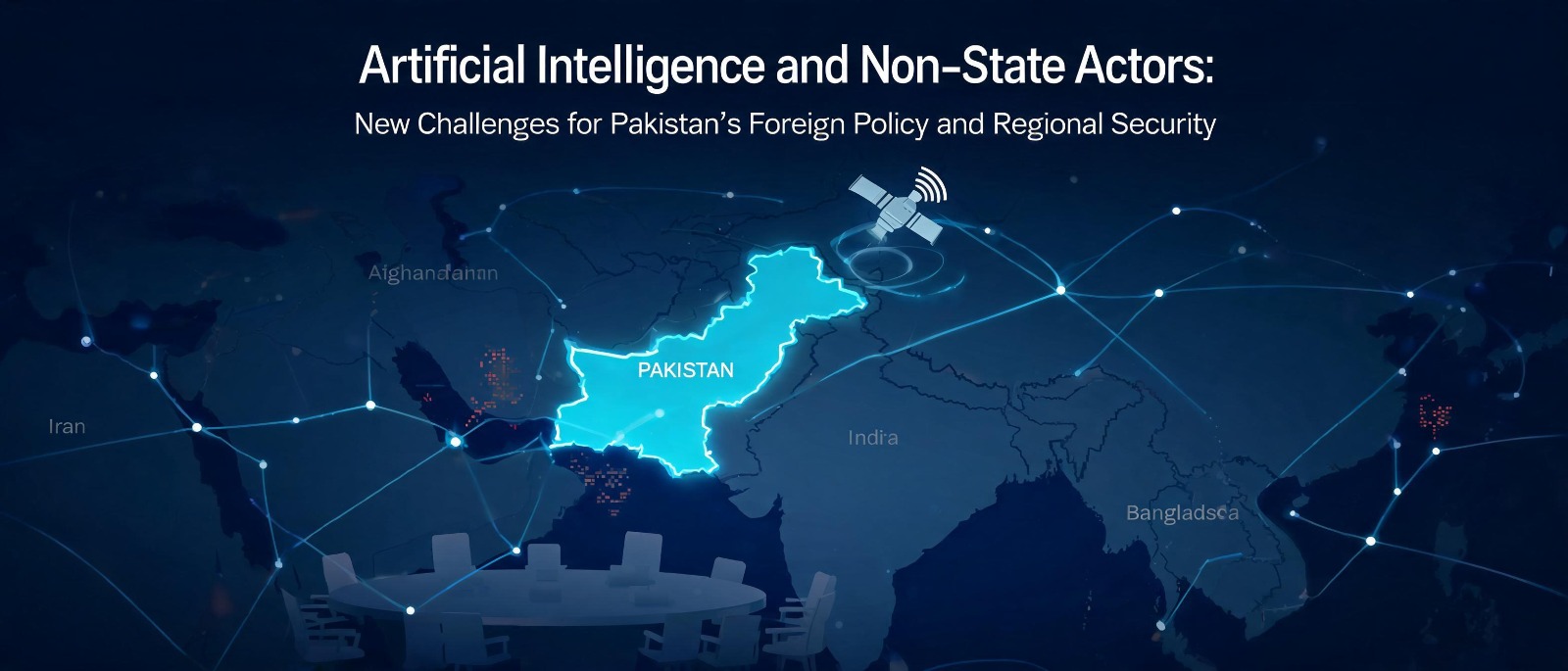
Artificial intelligence is reshaping the security environment by reducing the cost, skill, and time required to conduct harmful operations. Tools once limited to states can now be used by non-state actors for propaganda, cyber operations, surveillance, and deception. This matters for Pakistan because the country already faces cross-border tensions, internal extremist violence, and a fragile information space. When AI strengthens non-state actors, the result is not only a domestic security problem. It also complicates Pakistan’s foreign policy by making threats harder to identify, harder to attribute, and easier to exploit in regional disputes.
Pakistan’s foreign policy operates in a difficult regional setting shaped by rivalry with India, uncertainty in Afghanistan, strategic ties with China, and pressure from wider international actors.
AI-enabled non-state actors add a new layer of instability to this environment.
Small groups can now generate persuasive fake content, launch cyberattacks, coordinate across encrypted platforms, and hide behind digital anonymity. The core problem is that these capabilities lower the barrier to high-impact disruption while weakening the state’s ability to respond quickly and credibly.
AI first expands the reach of propaganda and radicalization. Generative tools can produce realistic images, videos, speeches, and translated messages at scale, allowing extremist and criminal networks to target audiences more precisely than before. The problem is not only speed. It is also credibility. Deepfakes and synthetic content blur the line between real and fabricated material, making it easier to spread fear, recruit supporters, and shape public opinion. In Pakistan, where online rumor cycles often travel quickly through social media, such content can intensify polarization and create space for extremist narratives.
AI also strengthens cyber operations. Automated reconnaissance can help malicious actors locate weaknesses in banks, energy systems, communication networks, and public databases. AI-assisted malware can adapt, evade detection, and scale attacks more efficiently than older tools. For Pakistan, this is especially serious because disruption of financial services, transport links, or electricity infrastructure would not remain a technical incident. It would quickly become a strategic and diplomatic concern, since repeated cyber incidents can weaken confidence in state capacity and invite external suspicion about who is responsible.
A further concern is the use of drones, encrypted communications, and digital finance. Drones make it easier for non-state actors to observe, transport, and attack across borders. Encrypted channels allow dispersed groups to coordinate without direct physical contact, while cryptocurrencies and online payment systems can support fundraising and conceal financial trails. These capabilities matter for Pakistan because they make border management and counterterrorism more difficult along both the western frontier and the India-Pakistan border. They also increase the risk that local militant activity will acquire regional implications.
The most immediate foreign policy challenge is attribution. AI makes it easier to disguise the origin of an attack, manipulate evidence, and route operations through third-party infrastructure. That creates uncertainty about whether a threat came from an independent group, a proxy network, or a foreign sponsor. In South Asia, this is dangerous because even a fabricated video or a coordinated cyber incident can be misread during a crisis. Between India and Pakistan, where escalation risks are already high, AI-driven misinformation could accelerate miscalculation and narrow the space for diplomacy. AI-enabled non-state activity also damages Pakistan’s external image. Coordinated disinformation can portray the state as unstable, unsafe for investment, or unable to control violence. Such narratives matter in foreign policy because they influence diplomatic confidence, investment decisions, and perceptions in international forums. At the regional level, AI-assisted hybrid tactics blur the separation between online influence, cyber disruption, and on-the-ground violence. That makes security competition more complex and places greater pressure on Pakistan to respond with credible evidence rather than reactive statements.
Pakistan needs a response that connects domestic security with foreign policy planning. First, it should expand AI-enabled cyber defense and digital forensics so that malicious activity can be detected and attributed more reliably. Second, NACTA, intelligence agencies, and relevant civilian institutions should coordinate on online extremism, data sharing, and crisis communication. Third, Pakistan should invest in media literacy and fact-checking capacity to reduce the impact of deepfakes and false narratives. Fourth, Islamabad should take an active role in regional and international discussions on AI governance, because rules on responsible use, transparency, and terrorist misuse will shape future security conditions. Pakistan should also support confidence-building measures with neighbors on cyber incidents and information integrity, since crisis stability in South Asia now depends on more than military deterrence. The broader direction is already visible in Pakistan’s own AI policy framework, which emphasizes awareness, preparedness, and responsible adoption of AI.
Artificial intelligence has changed the balance between states and non-state actors by giving smaller groups tools that generate disproportionate effects. For Pakistan, the challenge is not simply technological. It is strategic. AI empowers propaganda networks, cyber attackers, and militant groups while making attribution more difficult and escalation more likely in a tense regional setting. The result is greater pressure on foreign policy, regional stability, and state credibility. Pakistan can respond only if it treats AI as both a security threat and a governance issue. A mix of cyber resilience, institutional coordination, public awareness, and international engagement offers the most practical path to protecting national security in an increasingly AI-driven environment. If Pakistan builds these capabilities early, it can reduce the space for hostile actors, protect its diplomatic interests, and improve resilience against the next wave of AI-enabled threats.