







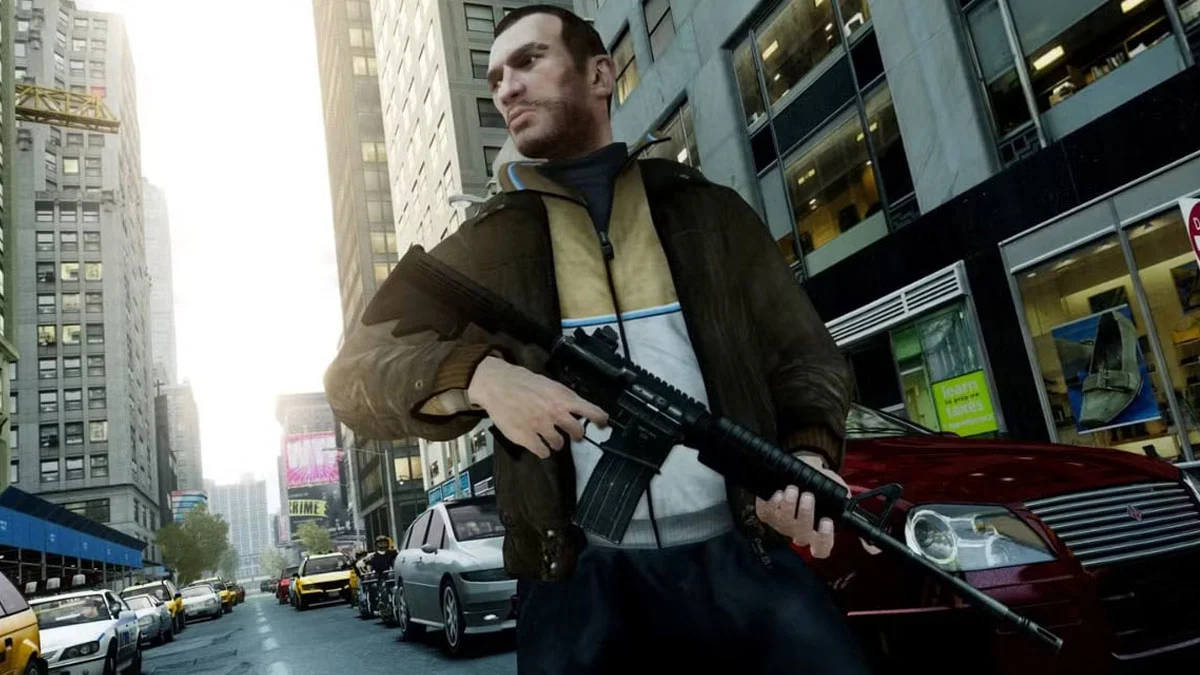
Upon its release in 2008, Grand Theft Auto IV (GTA 4) redefined open-world gaming. From its dark portrayal of Liberty City to the physics-driven Euphoria engine, Rockstar Games had pushed the hardware of 7th generation consoles to its extreme limits.
However, one of the studio’s most ambitious ideas for the game never saw its way into the final version: Fully-simulated, real-life daily routines for every NPC on the map.
In an interview with Edge Magazine, former Rockstar North Technical Director, Obbe Vermeij, explained how the former president of Rockstar Games, Leslie Benzies, once had the vision of a live, breathing city in which civilians had unique, realistic schedules.
The Cut Vision: Work commutes and homes for Liberty City’s citizens
During the initial development phase of GTA IV, Leslie Benzies proposed the implementation of an intricate schedule system to determine the daily routine of the average Liberty City citizen. If this vision was to be carried out:
Every civilian NPC would have an assigned home in Liberty City.
NPCs would have to leave their homes every morning to physically commute to their workplaces in order to fulfill their designated schedules before heading back home at the end of the day.
If fully implemented, this would give Liberty City a depth unseen before in action-adventure games of its time, but this idea soon encountered major technical problems.
Technical Limitations: bugs, technical friction, and failure
According to Vermeij, having every pedestrian on the street behave as a scheduled entity created a huge amount of bugs. Supporting hundreds and thousands of NPC entities with individual locations, pathfinding, and driving behaviors put a very heavy strain on CPU processing power and memory.
Mission volatility: If the mission’s target was stuck in traffic, taking the subway, or even at home when they weren’t supposed to be there, the entire mission was ruined.
Interference from the player: Grand Theft Auto’s addictive gameplay comes from the chaos it thrives in, allowing you to drive crazily at speeds, but a rigid schedule framework wouldn’t recover if the player interfered with its schedule, at least not successfully.
“Leslie Benzies had the desire for all [NPCs in GTA 4] to have their own life, homes, their own schedule, they get up and commute to work in the morning,” explained Vermeij in the interview with Edge Magazine. “We did start toward this, but it was so problematical… There was a huge number of bugs that we had. ”
The “Fake” Realism of open-world games
Vermeij actually personally argued against the mechanic at the time, saying hyper-realism isn’t necessarily better gameplay. A perfect example of a game that had too many complex mechanics, where the “Radiant AI” caused many bugs (shopkeepers can wander off and get themselves killed off screen, leaving their shop permanently closed), is The Elder Scrolls IV: Oblivion.
Instead, Vermeij believes that players want an illusion of reality, not quite reality itself. “I actually think that players (psychologically) are perfectly fine with the NPCs being a little bit fake and shallow,” stated Vermeij. “I don’t think games really need to go for realism.”
The complex schedule system was ultimately cut in favor of the dynamic citizen interactions we all know of today from Grand Theft Auto IV, where pedestrians may simply react to the weather, read a newspaper, smoke a cigarette, or carry some groceries.
This “fake” realism provides the level of depth required by the game’s world while not being so complex that it hinders performance, stability, and gameplay.
Quality over quantity of mechanics
Rockstar Games is no stranger to abandoning ambitious mechanics when they are too difficult to perfect. While GTA IV took some of its mechanics away in comparison to San Andreas (customization being one of them), the company’s decision to remove flawed background systems is ultimately what made the game one of the highest-rated titles ever released.
Future titles, such as Grand Theft Auto VI, will benefit greatly from the lessons learned by Rockstar Games and Vermeij’s insight into the art of building a good open-world.