






Small Plane Crashes Into Tallest Building in Beijing
Crowds in the capital’s central business district fled as the crash sent debris falling into the streets below.
Crowds in the capital’s central business district fled as the crash sent debris falling into the streets below.
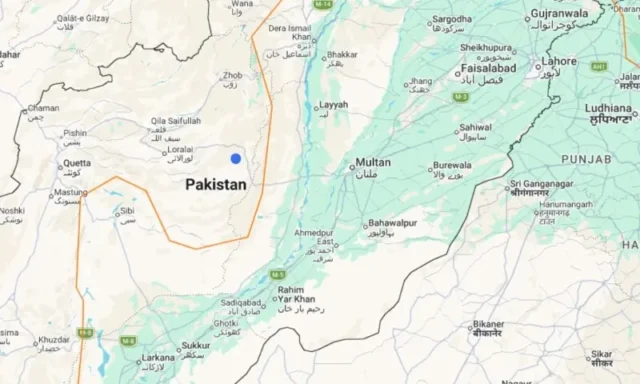
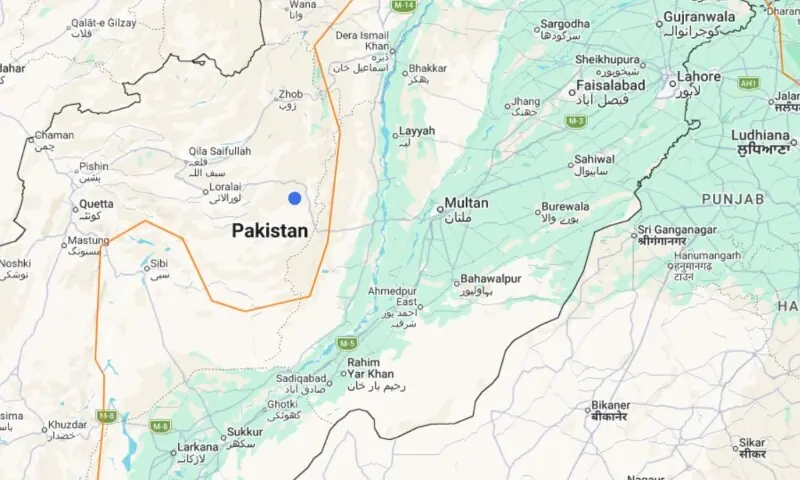
A 5.1-magnitude earthquake jolted parts of Balochistan on Friday, according to the Pakistan Meteorological Department (PMD).
In a press release, the PMD said the quake’s epicentre was 60 kilometres northeast of Kohlu and that it was felt in the Zhob, Barkhan and Rakhni areas.
PMD further said that the quake occurred at 4:48pm at a depth of 17km.
Meanwhile, the United States Geological Survey (USGS) reported that a 5.2 magnitude quake was recorded north-northeast of Barkhan, at a depth of 10km.
Earlier this week, a 5.4-magnitude earthquake jolted parts of Khyber Pakhtunkhwa, Punjab and Islamabad on Monday.
According to the PMD, the earthquake was recorded at 3:22pm at a depth of 215km with the Hindu Kush region in Afghanistan as its epicentre.
It was felt in Peshawar, Islamabad, Mansehra, Swat, Battagram, Abbottabad, Lahore, Rawalpindi, Attock, Chakwal, Mianwali, Multan and Potohar region, among other areas.
Last month, at least one person was killed and 11 others were injured after several houses were seriously damaged following a reported earthquake in Jhelum’s Pind Dadan Khan tehsil, the area administration said.
According to a press release issued by the PMD, an earthquake measuring 4.8 struck the region.
Pakistan falls on three major tectonic plates — the Arabian, Euro-Asian and Indian — which create five seismic zones under the country. The intersection of multiple fault lines means that tectonic movements remain a frequent occurrence in the region.
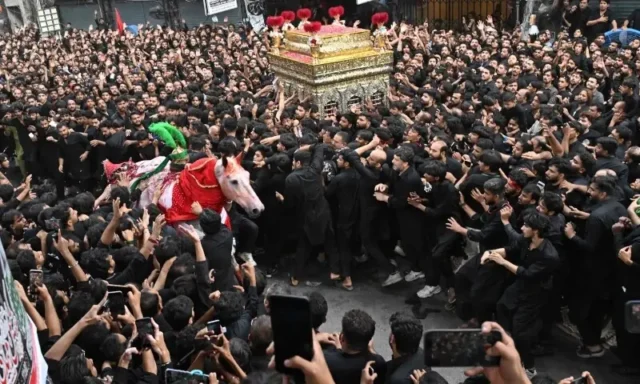
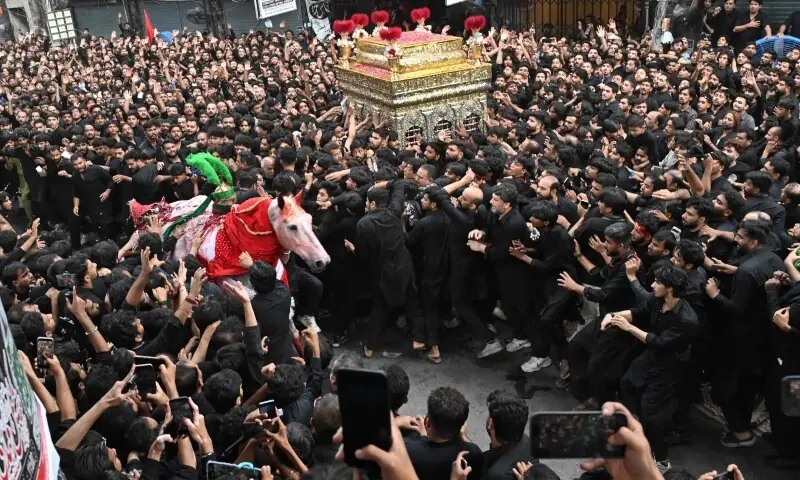
Elaborate security arrangements have been made countrywide today as scores of mourners take out Muharram 10 processions in observance of Yaum-i-Ashura.
Yaum-i-Ashura is observed every year with mourning processions and religious gatherings to commemorate the martyrdom of Imam Husain (RA) and his companions in the Battle of Karbala in 680AD.
The central procession in Karachi departed from Nishtar Park at around 9:30am. It will conclude at Imambargah Hussainia Iranian after passing through its traditional routes.
In Hyderabad, the central procession emerged from Qadam Gah Maula Ali off Station Road and will culimate at Karbala Dadan Shah.
Meanwhile, 12 processions are planned for Peshawar. Among them, the first one departed Imambargah Agha Syed Ali Shah near Meena Bazaar at around 11am. The remaining are schedule to depart from various locations at varying times between 12pm and 3pm.
No procession would be taken out in Islamabad, but the main procession in Rawalpindi was planned to be taken out from Imambargah Ashiq Hussain in Taili Mohallah and culminate at Imambargah Qadeemi.
In Lahore, the central procession emerged from Nisar Haveli.
Meanwhile, commuters in various cities have been advised to take alternative routes, in line with traffic plans devised in view of closure of roads while the processions are held. Elaborate security arrangements are also in place to ensure mourners’ security.
Karachi police chief Azad Khan said on Thursday that mobile phone and internet services would likely be suspended along the route of the main procession today. He said around 6,500 policemen would be deployed to secure the main procession, while the overall deployment across the city would stand at 20,000 personnel.
Earlier, traffic police shared a plan for alternative routes for commuters. “Due to security reasons, M.A. Jinnah Road will be closed to traffic from Gurumandir to Tower,” the traffic police’s statement said.
Sindh CM Murad Ali Shah joined a mourning procession on Friday, where he said while speaking to the media that 60,000 police and Rangers personnel had been deployed for the processions’ security in Sindh, where over 1,600 processions are taken out in Muharram.
Security arrangements have also been put in place in Rawalpindi, with the deployment of five Army companies, seven Rangers companies and thousands of police personnel.
On the recommendation of intelligence agencies, the Punjab government has suspended the Metro Bus Service between Rawalpindi and Islamabad as officials said the mourning procession would pass along Murree Road from Bhabra Bazaar to Committee Chowk beneath the metro track, giving rise to security concerns.
Two video monitoring control rooms, one at the Punjab Safe Cities Authority and another at the Rawalpindi Municipal Corporation, will monitor the processions, gatherings and sensitive locations.
Section 144 has also been imposed in the Rawalpindi district, and Rawalpindi police said more than 8,000 personnel would perform security duties during Muharram, including 5,500 deployed for the main Ashura procession.
According to a police spokesman, roads and streets along procession routes have been sealed, snipers have been deployed on rooftops, and participants would undergo body searches before entering processions.
More than 2,000 Safe City and other CCTV cameras are monitoring the city, with surveillance continuing from Safe City and the central control room. Special pickets have also been established at entry and exit points of the city.
Police have also developed a mobile application for the identification and scanning of identity cards at pickets and bus terminals.
A total of 475 processions and 2,201 majalis are scheduled to be held across the Rawalpindi district during Muharram.
In Punjab, medical and emergency services, including Rescue 1122, Civil Defence personnel, mobile health units, field hospitals and volunteers, have been deployed to assist mourners, officials said,
Sanitation workers have also been assigned to ensure cleanliness along procession routes and around religious sites.
A three-tier security plan has been implemented province-wide, under which more than 125,000 police personnel have been deployed while 61 companies of the Pakistan Army and 76 companies of Rangers have been requisitioned to support security arrangements.
In addition, over 30,000 trained volunteers are assisting law-enforcement agencies.
The authorities are using modern surveillance technologies, including artificial intelligence-based monitoring systems, CCTV cameras, body-worn cameras and geo-tagged video monitoring.
The Provincial Intelligence Centre is also conducting round-the-clock monitoring of processions and majalis through a digital surveillance wall.
Over 5,600 CCTV cameras are operational for Muharram monitoring, while more than 1,000 4G event cameras have been installed at sensitive locations.
A statement issued by the Punjab Home Department said mobile phone services would be partially suspended in 24 districts of Punjab, namely Rawalpindi, Attock, Chakwal, Sargodha, Khushab, Bhakkar, Hafizabad, Gujrat, Narowal, Faisalabad, Toba Tek Singh, Jhang, Chiniot, Multan, Sahiwal, Okara, Pakpattan, Dera Ghazi Khan, Rajanpur, Muzaffargarh, Layyah, Kot Addu, Bahawalnagar and Rahimyar Khan.
The service would remain suspended at the locations of religious gatherings until 10pm, the statement said.
In Peshawar, police had chalked out a plan to deploy 12,000 personnel in the city for security during Muharram processions.
A statement by police said that personnel from the city police, rapid response force, quick response force, ladies traffic police and bomb disposal units were to be deployed for security in Muharram.
It added that three-layered security would be provided to all mourning processions, while marksmen would be set up at high-rise buildings along the procession routes. In addition to this, 1,000 traffic personnel were also to be deployed to ensure the smooth flow of traffic across the city.
Similarly, bomb disposal units and sniffer dogs were to be deployed to sweep imambargahs, majalis and procession routes, the statement said, adding that personnel in plain clothes had also been deployed at sensitive locations and places of worship across the city.
Last week, KP IG Zulfiqar Hameed directed police officials to enhance daily coordination with district administrations and peace committees at the district level to prevent any unpleasant incident during Muharram.
Separately, a police statement said Muharram processions and religious gatherings on Ashura would be monitored through the Safe City camera network in Peshawar.
It further stated that 43,317 police personnel would be deployed across the province to perform security duties during Muharram, and Section 144 had been enforced in various districts of KP.
The statement said that out of 614 imambargahs across the province, 127 had been declared highly sensitive, 262 sensitive and 225 normal and that a total of 907 Muharram processions were expected to be taken out across the province, with 286 being highly sensitive, 190 sensitive and 431 normal.
The Balochistan government also finalised stringent security arrangements for Muharram 10, deploying more than 32,000 security personnel to ensure the safety of Ashura processions.
The main procession routes are to be monitored continuously through aerial surveillance and a comprehensive network of CCTV cameras while all shops, markets, plazas, and commercial centres along the procession routes have been sealed.
According to official sources, more than 17,000 personnel have been deployed exclusively in Quetta. These forces will guard the main procession routes, key public spaces, and all entry and exit points of the city. The deployment includes personnel from the District Police, Balochistan Constabulary, Rapid Response Force (RRF), Anti-Terrorist Force (ATF), Frontier Corps (FC), and the Anti-Riot Force.
As part of the security protocol, mobile phone services and internet connectivity have been suspended across Quetta and other sensitive areas of Balochistan while the procession is taken out.
“This is a victory 10 years in the making,” a White House official said after the Supreme Court ruled that the Trump administration could end deportation protections for some migrants.
The presentation of an original German-language translation in Berlin is an opportunity to consider the shared history of the United States and Germany.
Mr. Bolton is expected to admit to mishandling classified information and could face time in prison, in an inquiry that spanned the Trump and Biden administrations.
Our Times correspondent, Vivian Wang, was expelled from China as part of Beijing’s crackdown on foreign journalists. She explains how a pressure campaign by the authorities made it challenging to do her job.
For a mega-refinery in Ulsan, South Korea, a top exporter of jet fuel to the West Coast of the United States and other places, weaning off Middle Eastern oil is no small feat.

LAHORE – The Punjab government has finalised an extensive province-wide security and facilitation plan for Muharram-ul-Haram, deploying more than 125,000 police personnel, launching a digital monitoring system for imambargahs, and introducing new public facilitation measures under the direct supervision of Chief Minister Maryam Nawaz Sharif. Officials said the administration had remained on high alert for the past eight days to ensure the peaceful conduct of Muharram processions and majalis across the province. This year, the government has adopted what it describes as a new administrative model that combines stringent security arrangements with measures aimed at facilitating mourners. In a first, anti-smog guns and sprinkler systems have been deployed in several districts to spray water along procession routes, providing relief from intense heat and humidity during the observances. A major feature of the plan is the introduction of a digital monitoring system linking all 4,836 imambargahs in Punjab through QR codes. Authorities said the system would enable organisers and government agencies to communicate more efficiently and allow real-time reporting and response. Organisers of majalis have been encouraged to use the QR-based platform. Special arrangements have also been made for the provision of cold drinking water, while mobile health units, field hospitals, Rescue 1122 teams, Civil Defence personnel and volunteers have been stationed along procession routes. Additional sanitation staff has been deployed to maintain cleanliness around imambargahs and gathering sites.
To maintain law and order, a three-tier security strategy has been enforced across the province. More than 125,000 police officers and personnel have been deployed, supported by 61 companies of the Pakistan Army, 76 companies of Rangers and over 30,000 trained volunteers.
The chief minister is personally overseeing the arrangements, while district administrations and law-enforcement agencies have been directed to remain on high alert throughout the mourning period. Authorities have also activated a cyber-patrolling unit to monitor social media platforms for hate speech, sectarian content and incitement. According to officials, more than 6,000 social media accounts and objectionable online posts have been reported to the Pakistan Telecommunication Authority (PTA) for action. To ensure uninterrupted communication and coordination, particularly during any disruption of conventional networks, the provincial government has launched its own LTE-based communication system. Live CCTV feeds from processions and majalis are being monitored at the Provincial Intelligence Centre, while provincial and district-level control rooms have been placed on round-the-clock alert. Officials said over 5,600 CCTV cameras, 1,040 body-worn cameras and more than 1,000 4G event cameras have been deployed to strengthen surveillance and monitoring. In addition, 43 intelligence-based operations have been conducted across Punjab ahead of Muharram as part of preventive security measures.
The government has reiterated that no new processions or gatherings will be permitted beyond those traditionally held and officially licensed. A comprehensive digital map of all majalis and processions has also been prepared, while a dedicated hotline between the provincial government and religious scholars remains operational to promote inter-sect harmony and address emerging concerns. As part of security restrictions, Section 144 has been imposed across Punjab. Standing on rooftops along procession routes, displaying weapons, misuse of loudspeakers, wall chalking and delivery of provocative speeches have been prohibited. Officials warned that strict legal action would be taken against violators. Preventive measures have also been taken against individuals considered a potential threat to public order. Restrictions have been imposed on 794 clerics, while 1,418 individuals have been barred from entering specified areas. Motorcycle pillion riding will remain banned across the province on the 9th and 10th of Muharram. Officials said the provincial cabinet committee on law and order had completed visits to all nine divisions of Punjab to review preparations. Meanwhile, peace committees have held 1,220 meetings at the grassroots level to strengthen coordination among communities and stakeholders. According to official estimates, a total of 47,280 Muharram gatherings are expected to take place across Punjab, including 37,868 majalis and 9,412 processions.
LAHORE – Metro bus service, electric buses, speedo bus service will remain closed on 9th and 10th Muharram across Punja. According to Punjab Mass Transit Authority, metro, electric and speedo bus services have been closed due to security concerns. Services will remain suspended in Lahore, Multan and Rawalpindi. Meanwhile, City Traffic Police Lahore (CTPL) has issued a traffic advisory for the 9th Muharram mourning procession scheduled to proceed from Islam Pura to Khaima-e-Sadaat via Pando Street. Chief Traffic Officer (CTO) Syed Abdul Raheem Shirazi said that all necessary arrangements had been completed to ensure smooth traffic flow and facilitate mourners during the procession. He said SP City Maqsood Lone would supervise the traffic arrangements, while special measures had been taken to keep routes clear for emergency vehicles throughout the procession. The CTO said traffic diversions would remain temporary and roads would be reopened immediately after the passage of the procession. “Traffic at diversion points would only be stopped for a short time and restored as soon as the procession moves forward,” he added. According to the traffic advisory, traffic coming from Chowk Civil Secretariat towards Islam Pura would not be allowed, while all kinds of traffic from Sanda Road towards Pando Street will remain restricted. Similarly, traffic from Chowk Sanda Khurd via Haider Road towards Neeli Bar, as well as traffic approaching from Last Bus Stop and Sanda Road towards Noori Building, would not be permitted during the procession. Restrictions would also remain in place from Neeli Bar Turn towards Neeli Bar Chowk, Chowk Tollinton Market towards Old Anarkali, Baba Mauj Darya towards Khaima-e-Sadaat, and from Jain Mandar Chowk towards Edward Road and Khaima-e-Sadaat. Traffic from Farid Kot Road towards Jain Mandar and Khaima-e-Sadaat, as well as from Jain Mandar Chowk towards Old Anarkali, would also be diverted. The CTO said alternative routes had been designated to minimise inconvenience to commuters. Traffic from Last Bus Stop would be diverted through Sanda, Firdous Cinema, Sanda Road and MAO College, while vehicles from MAO College and Sanda Road would be able to access Sanda through Last Bus Stop. Traffic coming from Azadi Flyover would be diverted at District Courts Chowk towards the G.C. College roundabout, while heavy traffic from Ferozepur Road would be diverted from LOS Chowk towards Ganda Nala. Likewise, traffic approaching from Multan Road would be diverted from Samanabad Mor towards Double Roads and Ring Road. Shirazi urged citizens to cooperate with traffic wardens, follow the advisory and use alternative routes to avoid inconvenience. He said no diversion would remain permanent and traffic would be managed according to the movement of the procession. The restricted areas include Pando Street Islam Pura, Block Sadaan Islam Pura, Main Bazaar, Chishtia High School Road, Haider Road, Civil Secretariat Chowk, Nabha Road, Church Road, Edward Road, Khaima-e-Sadaat, Jain Mandar Chowk, McLeod Road and Old Anarkali.