







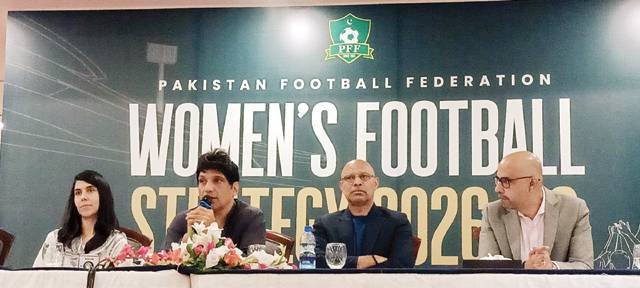

LAHORE – The Pakistan Football Federation (PFF) on Monday unveiled its Women’s Football Strategy 2026-2030, introducing a national five-year roadmap designed to take women’s football from grassroots participation to the elite level while creating structured pathways for players, coaches, referees, administrators and future leaders. Launched in Islamabad under the theme “From Paper to the Pitch,” the strategy is built around five pillars: participation and competitions; player development and high performance; education and capacity development; visibility, engagement and growth; and governance and leadership.
The plan targets expanded school, club and academy participation, regular competitions and a tiered national, provincial and district league system. It also proposes a national talent-identification framework and comprehensive player-registration system to ensure promising players can progress through the system regardless of where they are discovered. PFF President Syed Mohsen Gilani described the initiative as a landmark moment, noting that Pakistan’s women’s team had recently participated in a FIFA event and was ranked above the men’s side. “Our women’s team has created history by participating in a FIFA event,” Gilani said, adding that the federation’s priority was to improve national-team performance, strengthen youth development and build a complete football ecosystem for women.
The strategy envisages Regional Training Centres, national youth programmes and a dedicated Women’s National Team High-Performance Framework. It also calls for regular international exposure for youth sides and at least 10 international matches annually for the senior women’s team.
Head of Women’s Football Mejzgaan Orakzai said the federation was building on existing foundations rather than starting from scratch. Pakistan currently has 62 registered clubs and academies, 673 registered female players and five certified women referees, while the last AFC “A” Licence coaching course for women was held in 2020. Under its education pillar, the strategy aims to train and certify at least 250 female coaches across four regions and increase registered female referees to 100. The federation also plans outreach programmes to engage at least 2,000 girls annually across the four regions, alongside stronger media partnerships, marketing, fan engagement and commercial development. PFF Technical Director Adeel Rizki stressed that youth development would be central to the strategy’s success, while Prime Minister’s Coordinator for Inter-Provincial Coordination Syeda Mehreen Sajid urged the federation to extend its programmes to smaller towns where considerable talent remains untapped.
By 2030, the PFF aims to establish a professional, inclusive and safe women’s football structure capable of consistently producing players for the national team while opening greater opportunities for women across all areas of the sport.