Bills

Home Bills Page 71

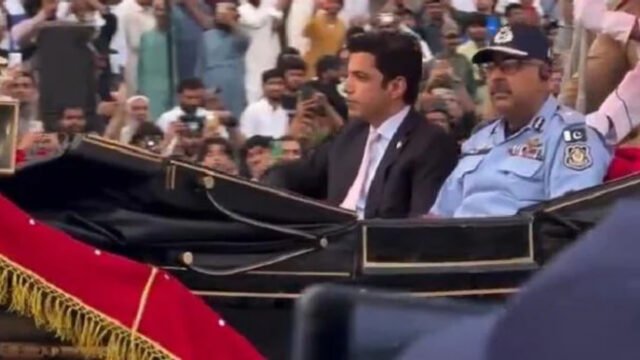
PM Shehbaz takes ‘strict notice’ of officials’ horse-drawn carriage arrival

0


The Prime Minister of Pakistan, Shehbaz Sharif, has taken “strict notice” of an incident in which Islamabad’s chief commissioner and inspector general of police (IGP) arrived at an official 14 August ceremony in a horse-drawn carriage.

The prime minister expressed his disappointment and disapproval over the incident, following which the Establishment Division issued separate written warnings to the two senior officials.

The warnings said their arrival in the carriage created an impression of privilege and showiness, describing such conduct as contrary to the principles of public service.

Government officials, the Establishment Division said, hold their positions in trust on behalf of the public and are expected to demonstrate humility, restraint, dignity and sound judgement.

It warned that such behavior could undermine public confidence in government institutions and stressed that senior officials must uphold the standards of conduct expected of them.

The Establishment Division said the capital’s administrative head was expected to maintain the highest standards of official conduct.

According to the documents, Prime Minister Shehbaz Sharif directed the officials to exercise greater caution in the performance of their duties and instructed them not to repeat such behavior in the future.

The Establishment Division ordered the officials to comply fully with the prime minister’s instructions.

Why China Thinks It Can Resist Trump’s Economic Threats on Iran

0


Beijing can squeeze U.S. critical mineral supplies and has enough oil to withstand the loss of Iranian crude, Chinese analysts say.

Palestinian Teenager Killed After Israeli Settlers Enter West Bank Village

0


Palestinian and Israeli authorities offered divergent accounts of the incident, which came as settler violence has surged across the Israeli-occupied territory.

Lahore Gymkhana power-sharing deal stalls as Siddique retains chairmanship

0


LAHORE   –  The planned rotation of the La­hore Gymkhana Club chair­manship failed to take place on Wednesday after two members of the rival “Monopoly Break­ers” group allegedly voted in favour of incumbent chairman Salman Siddique, allowing him to retain the position for anoth­er six months.

The development has trig­gered a fresh dispute within the club’s 12-member manage­ment committee, with the two factions offering conflicting ac­counts of the circumstances that led to Wednesday’s vote and the continuation of Mr Sid­dique as chairman. The club’s 2026-27 elections, held in Feb­ruary, resulted in an evenly di­vided management committee, with six members elected from Mr Siddique’s traditional group and six from the newly formed Monopoly Breakers group led by Ahmed Nawaz Sukhera.

Following the 6-6 result, the two sides reportedly reached a power-sharing arrangement under which Mr Siddique would serve as chairman for the first six months and Mr Sukhera would take over for the follow­ing six months. Members of the Monopoly Breakers group said the arrangement was also re­corded in the minutes of the rel­evant meeting.

With Mr Siddique’s six-month term ending, the chairmanship was expected to pass to Mr Suk­hera. However, Wednesday’s management committee meet­ing took an unexpected turn.

Members of the Siddique group said two Monopoly Breakers members, Dr Ali Raz­zaq and Dr Jawad Sajid, voted in favour of Mr Siddique, enabling him to retain the chairmanship.

Kamran Lashari, a member of the Monopoly Breakers group, alleged that the Siddique group had agreed to the six-month ro­tation after the February elec­tions and had supported Mr Suk­hera’s appointment as chairman for the second half of the term.

“The decision was recorded in the minutes. Now they have backed out, saying it is politics and that the numbers are on our side,” Mr Lashari said.

The meeting had initially been convened to discuss the dis­bursement of enhanced salaries to club employees. Mr Siddique, however, said other matters also came under discussion.

Giving his account of the pro­ceedings, Mr Siddique said he had announced at the outset that Wednesday would be his last day as chairman. However, he said, the discussion subse­quently turned to other issues and a majority of committee members expressed opposition to the policies of the Monopoly Breakers group.

Mr Siddique said he had sug­gested that the differences be resolved within the group. Ac­cording to him, Mr Lashari then proposed that the matter be set­tled through a vote. He said seven of the 12 committee members vot­ed against the Monopoly Breakers group’s position and asked him to continue as chairman.

Mr Siddique said he would seek to resolve the dispute am­icably at the next management committee meeting, which he expected to be held on Tuesday or Wednesday.

He also said he had asked Mr Sukhera to resolve differences with members of his own group who did not agree with its pro­posed agenda for change.

“Sukhera is like my son,” Mr Siddique said, adding that he had urged him to take all mem­bers of his group along.

He expressed hope that the differences would be resolved at the next meeting.

The dispute has effectively stalled the proposed rotation of the chairmanship and deep­ened the power struggle that emerged following the Febru­ary elections. The Monopoly Breakers group had challenged the long-standing dominance of the traditional group and se­cured six of the 12 seats on the management committee, with its supporters viewing the re­sult as a mandate for change in the club’s administration.

The latest development has raised questions about the sta­tus of the reported six-month power-sharing arrangement and whether the agreed trans­fer of the chairmanship can still take place.

It has also placed the votes of the two members who allegedly backed Mr Siddique under scru­tiny, as their support altered the balance within the evenly divid­ed committee and enabled him to remain chairman.

Two killed as torrential rain triggers house collapse in Swabi

0


SWABI  –  A man and his daughter were killed while his wife and son sustained critical injuries when the roof of their house collapsed amid torrential rain in Azad­khel, Topi, on Thursday, Rescue 1122 officials said.

The incident occurred af­ter midnight when the fam­ily was asleep. According to Rescue 1122 Swabi spokes­man Luqman Khan, a bounda­ry wall collapsed onto the roof of the house, causing it to cave in and trapping the family be­neath the debris.

The area is mountainous, with houses built at different eleva­tions, making them particular­ly vulnerable to such incidents during heavy rainfall.

Neighbours were alerted by the sound of the collapsing wall and roof and immediately raised the alarm through loudspeakers before informing Rescue 1122. Local residents also began ef­forts to rescue those trapped before dawn, officials said.

Rescue teams subsequent­ly reached the site and recov­ered the victims from the de­bris. The injured and bodies of the deceased were shifted to the Tehsil Headquarters Hospital, where the injured were admit­ted for treatment and the bod­ies were handed over for med­ico-legal procedures.

The deceased were identi­fied as Muhammad Fareeq, 50, and his 28-year-old daughter. Fareeq’s 45-year-old wife and 30-year-old son, Awais Khan, were injured in the incident.

Meanwhile, Rescue 1122 Swa­bi responded to multiple inci­dents involving building col­lapses and flooding across the district, evacuating more than 300 people from affected areas and shifting them to safer loca­tions.

Floodwaters also entered a National Bank branch in Kun­da, Chota Lahor tehsil. Res­cue officials, however, reject­ed reports that a person was trapped beneath the rubble of the building.

In the Jarando Canal area, two people became stranded by floodwaters and called for help. A house also collapsed in the area, but rescue personnel safe­ly evacuated the occupants.

Five people were injured when a building collapsed in the Azamabad police post area.

KP Agriculture Department opens GIS Lab to modernise crop reporting

0


PESHAWAR   –  Adviser to the Khyber Pakhtunkhwa Chief Minister on Agriculture Mian Muhammad Umar inaugurated a Geo­graphic Information System (GIS) Lab at the Directorate General of Crop Re­porting Services in Peshawar on Thurs­day and inspected various sections of the newly established facility.

Relevant officials briefed the adviser on the objectives of the lab, its working mechanism and the use of modern ge­ospatial technology in crop reporting and agricultural planning.

Director General Agriculture Exten­sion Dr Naveed, Director Soil and Wa­ter Conservation Samiullah and other senior officers were also present.

Speaking on the occasion, Mr Umar said the use of modern technology and scientific methods was essen­tial for strengthening the agricul­ture sector. He said the adoption of advanced technologies would help ensure more accurate estimates of crop production and facilitate time­ly assessment of agricultural loss­es caused by climate change and ex­treme weather events.

The adviser directed that farmers’ registration at Farmers Model Farm Services Centres be ensured to facili­tate their access to agricultural servic­es. He stressed the need for regular and effective coordination between agricul­ture officers and farmers and called for measures to improve the performance, quality and effectiveness of the Model Farm Services Centres.

Director General Crop Reporting Ser­vices Syed Altaf Ahmed Shah gave a de­tailed briefing on the newly established GIS Lab, saying it had been set up with­in a short period under the Food Securi­ty Support Project Khyber Pakhtunkh­wa, implemented with the support of the Asian Development Bank.

He said GIS technology would fur­ther strengthen the capacity of Crop Reporting Services to estimate the production of major and minor crops, fruits and vegetables cultivated across the province.

The lab is equipped with modern equipment and staffed by profession­al personnel, he said, adding that the facility would enable the Agriculture Department to perform relevant tasks more efficiently, rapidly and on scien­tific lines.

Mr Umar said information generat­ed through the GIS Lab would be valua­ble for provincial planners, policymak­ers and relevant authorities. Reliable and timely agricultural data, he add­ed, would facilitate better and more re­sult-oriented decision-making.

He said the Khyber Pakhtunkh­wa government was giving special at­tention to modern technology and re­search in the Agriculture Department to improve facilities for farmers and address the challenges confronting the agriculture sector effectively.

Tax relief notification still awaited after KP Cabinet approval

0


SHANGLA   –  Despite approval by the Khyber Pakhtunkhwa Cabinet, the formal notification for withdrawal of pro­vincial taxes in Malakand Division, the former Provincially Admin­istered Tribal Areas (PATA) and the merged tribal districts is still awaited, prolonging uncertainty among residents, traders and the business community.

The delay has raised concerns among stakeholders, who have urged the provincial government to issue the notification without further delay and give legal and administrative effect to its an­nounced decision.

The imposition of provincial tax­es in Malakand Division and the former tribal areas has long been a contentious issue, with residents, traders, lawyers, journalists and political and social representa­tives arguing that the region’s his­torical and constitutional status should be taken into account be­fore imposing additional financial burdens on its people.

The issue gained renewed mo­mentum after a Grand Qaumi Jir­ga, attended by representatives from various parts of Malakand Division, discussed the matter at length and demanded withdraw­al of the taxes. Participants argued that the people of the region had legitimate grounds for seeking special tax treatment in view of its distinctive historical and constitu­tional circumstances.

Following sustained public pres­sure and consultations with stake­holders, the provincial govern­ment announced the withdrawal of provincial taxes from Malakand Division and the former tribal are­as. The announcement was wide­ly welcomed, with residents and traders expecting the decision to translate into immediate relief for businesses and ordinary citizens.

The Khyber Pakhtunkhwa Cab­inet subsequently approved draft notifications concerning the pro­posed tax exemptions for speci­fied sectors in Malakand Division and the former tribal areas.

However, the formal notification has yet to be issued, leaving un­certainty over the practical imple­mentation of the Cabinet decision. Stakeholders said the absence of an official notification had creat­ed confusion among taxpayers, businesses and government de­partments over whether the an­nounced exemptions were already applicable.

They said the Finance Depart­ment, Khyber Pakhtunkhwa Rev­enue Authority (KPRA), Account­ant General Pakistan Revenues (AGPR) and relevant accounts of­fices needed to be formally noti­fied of the decision through clear written instructions to ensure its uniform implementation.

The stakeholders warned that, without such directives, tax-col­lecting agencies could continue to apply existing provisions, poten­tially undermining the relief an­nounced by the government and creating further complications for businesses and citizens.

They called on Chief Minister, the provincial finance minister and senior officials of the Finance Department to intervene and en­sure the immediate issuance of the notification, with copies circu­lated to all relevant departments, institutions and tax-collecting agencies.

The stakeholders said the gov­ernment’s announcement, made after prolonged public pressure, consultations and the Grand Qa­umi Jirga, had generated consider­able expectations among the peo­ple. They therefore called for the process to be completed imme­diately and the Cabinet-approved tax relief to be given legal and ad­ministrative effect without any further delay.

They stressed that the decision should not remain confined to a government announcement or Cabinet approval, but should be im­plemented through formal admin­istrative orders so that residents, traders and businesses across the affected areas could actually bene­fit from the promised relief.

They warned that any further delay could undermine public confidence in the government’s commitment and prolong uncer­tainty for taxpayers and the busi­ness community in Malakand Di­vision, the former PATA and the merged tribal districts.

Sept 27 long march date unchanged: PTI

0


PESHAWAR   –  Khyber Pakhtunkhwa Information Minister Shafi Jan has said the Septem­ber 27 date announced for the Pakistan Tehreek-e-Insaf’s (PTI) proposed long march remains unchanged for now, while reiterating that the party re­mains committed to negotiations and political dialogue.

He said the door to dialogue re­mained open, but there would be no change in the September 27 schedule unless tangible and credible progress was made on the party’s core demands.

Mr Jan said two principal demands had been set out when the date was an­nounced at the August 5 public gather­ing. The first was that cases against PTI founder Imran Khan should be fixed for hearing and adjudicated strictly in ac­cordance with law and justice.

The second was his transfer, in view of his health condition, to a facility where he could receive appropriate medical care in the presence of family members and personal physicians.

He said the Supreme Court’s decision regarding Mr Khan’s transfer consti­tuted clear progress on the second de­mand and stressed that the order must now be implemented fully and without delay. He expressed concern over the delay in its implementation.

The provincial information minister said nothing was more important than Mr Khan’s health and that the matter should not be reduced to a political controversy. He said the government should have facilitated the transfer on humanitarian and moral grounds in the first place. With a judicial order now in force, he added, its implemen­tation was the government’s responsi­bility.

Mr Jan said the September 27 date was not intended as confrontation for its own sake but as a means of secur­ing constitutional, legal and political rights. He said the date would remain in place until the stated demands were addressed, while preparations for the movement would continue.

He said PTI had not issued a formal call for a movement since November 26, yet restrictions on its political ac­tivities had continued to intensify rath­er than ease. He claimed that Mr Khan had remained in isolation for an ex­tended period and that his sister had been able to meet him only after ap­proximately 265 days.

Mr Jan said whenever PTI’s politi­cal movement gained momentum or a date was announced, the government began talking about negotiations.

“Our position is clear: negotiations should take place, but they should not be used merely to buy time. What is re­quired is serious, clear and workable progress on the demands,” he said.

He said Chief Minister Muhammad Sohail Afridi was personally oversee­ing the overall process. The chief min­ister would visit Hangu on Saturday and Buner on Sunday as part of the po­litical mobilisation campaign, he add­ed.

Mr Jan said the chief minister would subsequently visit other parts of the province, while consultations with al­lied parties and the party leadership would continue regarding a broader political outreach campaign in Punjab, Sindh and Balochistan.

Rejecting speculation on social me­dia about a possible deal, Mr Jan cate­gorically denied any agreement, back­channel contact or intention to enter into a secret arrangement.

“If a deal had been the objective, Im­ran Khan would not have spent nearly 1,000 days in detention,” he said.

Imran Khan Is Granted Brief Hospital Visit Before Returning to Prison

0


The former prime minister of Pakistan, who was convicted on corruption charges, has been fighting a legal battle over his medical treatment.

Speakers call for empowered local govts to address governance crisis

0


LAHORE  –  Speakers at a discussion on administrative reforms called for political consensus, stronger local governments and continuity in state policies, warning that Pakistan could not afford to waste its economic and human potential amid mounting internal and external challenges. The discussion, titled “More Provinces or Empowered District Governments”, was organised by the People’s Information Bureau and Bhutto Shaheed Foundation at the SAIFMA Auditorium.  Senior PPP leader Chaudhry Aitzaz Ahsan said Pakistan needed a broad and organised movement to overcome its problems, warning that the country was “eating the future generations” by relying heavily on debt. He said local governments were not a substitute for new provinces and called for regular local elections. He said Pakistan’s problems had become so serious that political leaders needed to consider the country’s international interests while framing policies. He also criticised political divisions and called for greater national unity. PPP Central Punjab Information Secretary Shahzad Saeed Cheema described the 1973 Constitution as a social contract and said Pakistan’s basic problem was not a lack of authority but its distribution. He questioned whether provinces had actually become empowered after the 18th Amendment. Analyst Imtiaz Alam said Pakistan’s main problem was an authority-driven system. He questioned whether provinces had devolved sufficient powers to local governments despite the 18th Amendment. He also criticised the failure to regularly convene the Council of Common Interests. Barrister Aamir Hassan defended constitutionalism and said new provinces should be created through the constitutional process. He stressed that political differences should not be used to undermine democratic institutions and warned against making the armed forces a target of political criticism. Pakistan English Media Association (PEMA) representative and senior journalist Intikhab Hanif said that successive governments had introduced major policies and initiatives, only for their successors to reverse them after a change in government.

This policy inconsistency, he said, had cost the country dearly. He noted that no government allowed sufficient debate on the merits and shortcomings of its policies while in power, while those who supported such policies often began finding faults with them after the government was removed. He called for state policies to be formulated through consultation with all relevant stakeholders so that they enjoyed broad ownership and could be continued by successive governments.

Brigadier (retd) Dr Amin Amir Bahadur Hoti said political parties also had a role in bringing the military into politics. He called for national unity and warned that the debate over new provinces should not become as divisive as the Kalabagh Dam controversy.

PTI leader Ahmed Owais alleged that a system was operating in Pakistan without adequate regard for the Constitution and law and said restrictions on freedom of expression had made it difficult to openly discuss national issues.

Popular Posts

My Favorites

Indian authorities arrest staff accused of theft from temple built on...

0
Indian police have arrested eight people over allegations of theft and misappropriation of offerings at a temple that has been at the centre of...