







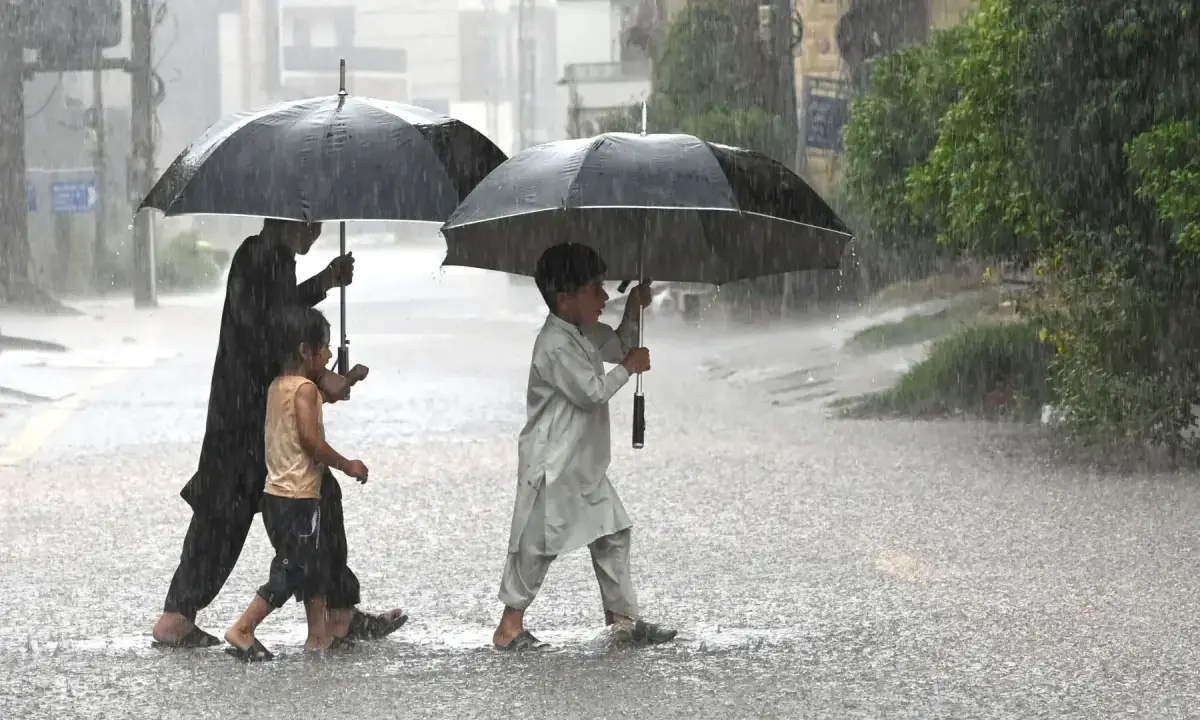
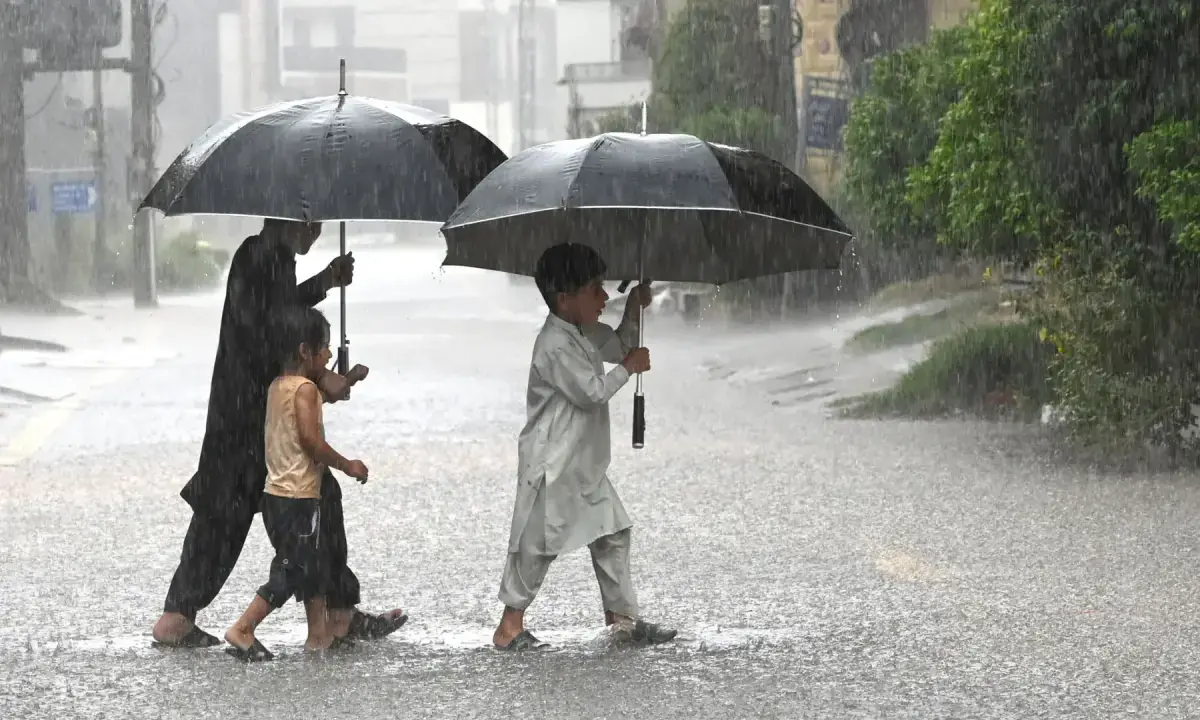
A fresh spell of rainfall is expected in the country from July 29 to August 5, the Pakistan Meteorological Department (PMD) said on Tuesday as several parts of the country reeled from a preceding spell and subsequent flooding.
“Monsoon currents from the Arabian Sea and Bay of Bengal are likely to penetrate upper and central parts of the country from July 29,” the Met Office said in its forecast, adding that a westerly wave currently affecting northern areas would likely strengthen from August 1 and affect most of the upper and central parts of the country.
PMD warned that heavy rainfall may cause urban flooding in low-lying areas of Islamabad, Rawalpindi, Peshawar, Nowshera, Gujranwala, Gujrat, Sialkot, Lahore, Multan and Faisalabad from July 30 to August 4.
It also warned of landslides in KP, particularly in Dir, Chitral, Swat, Kohistan, Buner, Battagram, Mansehra, Haripur and Abbottabad, as well as in GB, Murree, Galliyat and AJK from July 30 to August 5.
According to the advisory, heavy rainfall may also produce flash floods in “local streams/nullahs of Kashmir, Murree, Galliyat, northeastern Punjab, Islamabad, KP, GB, hill torrents of DG Khan and northeastern parts of Balochistan during the forecast period”.
It advised tourists to exercise caution during the forecast period.
The region-wise forecast issued by the PMD is as follows:
Azad Kashmir
According to the forecast, rainfall accompanied by wind or thundershowers is expected in Azad Jammu and Kashmir’s (AJK) Neelum valley, Muzaffarabad, Rawalakot, Poonch, Hattian, Bagh, Haveli, Sudhanoti, Kotli, Bhimber, Mirpur from the night of July 28 to August 5 with occasional gaps.
Punjab
In Punjab, scattered heavy to very heavy showers are expected in Islamabad, Rawalpindi, Murree, Galliyat, Attock, Chakwal, Jhelum, Mandi Bahauddin, Gujrat, Gujranwala, Hafizabad, Wazirabad, Sialkot, Narowal, Lahore, Okara, Kasur, Sheikhupura, Nankana Sahib, Faisalabad, Jhang, Toba Tek Singh, Chiniot, Khushab, Mianwali, Layyah, Bhakkar, Noorpurthal, Sargodha, Sahiwal and Pakpattan from July 29 to August 4 with occasional gaps, the Met Office said.
It added that in Bahawalpur, Bahawalnagar, Rahim Yar Khan, Khanpur, Multan, Vehari, Khanewal, Lodhran, Muzaffargarh, Kot Addu, Dera Ghazi Khan and Rajanpur, thundershowers with scattered heavy showers are expected from July 31 to August 3 with occasional gaps.
KP
In Khyber Pakhtunkhwa, rainfall with wind and thundershowers is expected in Dir, Chitral, Swat, Kohistan, Malakand, Nowshera, Charsadda, Karak, Tank, Lakki Marwat, Swabi, Shangla, Battagram, Buner, Kohat, Kurram, DI Khan, Bannu, Waziristan, Bajaur, Mohmand, Khyber, Orakzai, Mansehra, Abbottabad, Haripur, Peshawar, Mardan, Hangu from July 29 to August 5 with occasional gaps, according to the forecast.
GB
For Gilgit-Baltistan, the Met Office predicted rainfall and thunderstorms with moderate to heavy falls in Diamer, Astore, Ghizer, Skardu, Hunza, Gilgit, Ghanche, and Shigar from the evening or night of July 28 to August 6 with occasional gaps.
Sindh
In Sindh, rain and thundershowers with isolated moderate to heavy falls are expected in Karachi, Hyderabad, Tharparkar, Umer Kot, Mirpur Khas, Badin, Sanghar, Tando Muhammad Khan, Tando Allahyar, Matiari, Jamshoro, Shaheed Benazirabad, Ghotki, Kashmore, Jacobabad, Shikarpur, Sukkur, Qambar Shahdadkot, Larkana, Khairpur, Naushahro Feroze and Thatta districts from the evening of July 31 to August 2 with occasional gaps.
In Sindh, PMD warned of urban flooding in Nawabshah, Sukkur, Shaheed Benazirabad, Hyderabad, Thatta, Badin, Sanghar, Khairpur, Mithi, Mirpurkhas, Umerkot, Tando Muhammad Khan, Tando Allahyar from July 31 to August 2.
Balochistan
The Met Office further forecast rain-wind/thundershowers (with isolated heavy falls) in eastern/ southern parts of Balochistan including Zhob, Sherani, Loralai, Kohlu, Sibbi, Kalat, Naseerabad, Jhal Magsi, Jaffarabad, Barkhan, Dera Bugti and Khuzdar, Lasbela, Awaran, Turbat, Kech, Panjgur, Ormara, Pasni, Gwadar from July 31 to August 3 with occasional gaps.
Meanwhile, PMD’s Flood Forecasting Division in its daily outlook said that the Indus River at Kalabagh, Taunsa, and Guddu and the Ravi River at Balloki and Sidhnai continued to be in a low-flood situation.
It said that Indus at Guddu will attain medium-flood level in the next 24 hours, while a low-flood is expected to persist at Sukkur during the next 48 hours, after which it will attain medium-flood level.
Monsoon profile focused on country’s north: NDMA
Earlier in the day, in a televised briefing, an NDMA official informed Prime Minister Shehbaz Sharif and federal ministers that eastern Punjab and northern regions of the country are set to experience rainfall in the first ten days of August.
The NDMA official said, “The overall monsoon profile is still focused on the northern region of Pakistan, and intensity will be more pronounced towards the northern region in comparison to southern Pakistan.”
He noted that south and central Balochistan had not received any rainfall, and neither had any strong weather system impacted Sindh, noting a “regional contrast” in the weather system.
“The overall monsoon profile is still focused on the northern region of Pakistan,” he said, predicting that “in the first ten days of August, we would have rain activity particularly in eastern Punjab, northern regions of Pakistan, including KP, GB and AJK”.
Later, a statement issued by the PM’s Office (PMO) said that apart from the NDMA, chief secretaries of all four provinces, as well as GB and AJK, briefed the meeting on recent rains, resulting damages, and ongoing rescue and rehabilitation efforts.
The meeting was informed that the NDMA was providing all possible assistance and resources to provincial governments and institutions in response to flood conditions in the northern areas and the ongoing severe heatwave in Sindh and Balochistan, the statement said.
A major spell of monsoon rains was expected over the next two days in Azad Jammu and Kashmir, Gilgit-Baltistan, and southern Sindh, NDMA officials said, adding that another significant monsoon spell was expected across the country from the second week of September.
The meeting was further informed that the flood committee established on the prime minister’s instructions was meeting regularly and all relevant institutions were closely monitoring the situation while ensuring the implementation of a comprehensive strategy for rescue, relief, and rehabilitation.
According to details shared during the briefing, 110 people have lost their lives in rain-related incidents during the ongoing monsoon spell, 360 people have been injured, 796 houses have been damaged and
376 livestock animals have died.
The meeting was further informed that the ongoing global El Nino phenomenon has accelerated glacier melting in Pakistan’s northern regions, increasing the risk of Glofs and flash floods over the coming month, according to the PMO statement. Vulnerable areas have been identified and precautionary measures were being implemented, it said, citing details from the briefing.
The participants were further informed that immediate measures had been taken to control urban flooding in central Punjab, including Lahore, the statement said. In some areas, agricultural land has been inundated due to flooding in seasonal streams and drainage operations are under way, the participants were told.
Flood conditions in Dera Ghazi Khan and adjoining areas are currently under control, the PMO statement said.
The National Highway Authority (NHA) also briefed the meeting on road closures caused by landslides. According to NHA, roads at 106 affected locations have been reopened through timely action.
Moreover, the meeting was informed that the Ministry of Information Technology had activated the National Emergency and Telecommunication Centre, enabling Rescue 1122 to respond immediately to emergency calls made from any mobile phone.
Seven hundred locations have been identified across the country to store rainwater during the monsoon season so that it could be used for agricultural purposes during the dry season, the meeting was told.
PM orders preparedness for emergency situations
According to the PMO statement, the premier, who was chairing the review meeting on the ongoing monsoon rains and floods across the country, directed all relevant authorities to be prepared for any emergency.
He directed the NDMA to coordinate with provincial disaster management authorities (PDMAs) and provincial governments, as well as ensure the timely dissemination of information regarding the monsoon situation and rain forecast to all federal and provincial departments.
The prime minister further directed Planning Minister Ahsan Iqbal to chair the flood committee’s meetings on a daily basis and determine the appropriate course of action after reviewing the evolving situation.
He emphasised that the early warning system for Glacial Lake Outburst Floods (Glofs) and flash floods in the northern regions must remain fully operational.
The prime minister noted that while Pakistan’s contribution to global emissions was negligible, it continued to suffer from the adverse effects of climate change.
The government, he said, was “rapidly implementing” short-, medium-, and long-term measures to address the impacts of climate change.
The premier directed the NDMA that, in coordination with all relevant institutions, ensure that loss of life and property during the current monsoon spell was minimised.
For their part, federal ministers present at the meeting stressed a whole-of-government approach towards monsoon preparedness.
The planning minister addressing the briefing said, “We cannot stop floods or high temperatures, but we can take measures to protect lives, and this is why we have been focusing on strengthening our preparedness”.
Recalling the 2025 floods, the minister noted that “despite the scale of the flood, not many lives were lost,” attributing it to “timely” rescue and relief activities.
He added that the government was taking steps to monitor glacial melt and was working with China on agricultural research aimed at “producing weather-resistant varieties of crops” to ensure food security.
“With this whole of government approach, we are trying to minimise losses,” he added.
Finance Minister Muhammad Aurangzeb said that Pakistan had allocated $700 million annually to climate change for the next ten years under a country partnership framework (CPF) with the World Bank (WB), calling for “investable, bankable projects”.
In 2025, the WB had pledged to provide $20 billion to Pakistan under its country partnership framework (CPF) to support inclusive and sustainable development within the country.
Recalling the ten-year partnership framework, the finance czar outlined two key priorities within the programme — climate change and population.
“It is a programme of $2bn per year for the next ten years, which means for climate-related interventions, we have $700m available every single year,” he said, urging the need for “investable, bankable projects”.
“We have the funds available; now let’s utilise them properly,” he added.