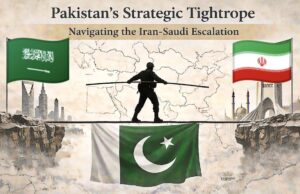







In world politics, influence is often associated with military strength, economic power and the ability to reward or punish. Yet a recent analysis published by South Asian Voices, a publication of the Stimson Center, highlights how Pakistan demonstrated that a middle power can exercise diplomatic influence through geography, credibility, access and timing. According to the analysis, Pakistan was uniquely positioned to facilitate dialogue between the United States and Iran. It shares a long border with Iran, maintains longstanding relations with the United States and possesses credibility within the wider Muslim world. Unlike major powers that can employ economic incentives or coercive pressure, Pakistan’s principal assets were access, relationships and strategic timing. The analysis describes this combination as Pakistan’s “geo-positional capital”.
Pakistan’s role also recalls its historic diplomatic contribution in 1971, when Islamabad facilitated Henry Kissinger’s secret visit to China. That initiative helped establish a channel between Washington and Beijing and eventually contributed to the normalization of US-China relations. Although the geopolitical circumstances are different today, the underlying principle remains similar: Pakistan possesses the ability to act as a bridge between states that lack suffic ient trust or direct communication.
The timing of Islamabad’s intervention was equally important. Drawing on conflict-resolution theory, the South Asian Voices analysis explains Pakistan’s intervention through William Zartman’s concept of a “mutually hurting stalemate.” This occurs when neither side believes it can achieve its objectives without incurring excessive costs, while continued conflict becomes increasingly painful for both. Such circumstances create what conflict-resolution theory calls “ripeness” for mediation.
Pakistan’s intervention came at precisely such a moment. Continued confrontation had imposed significant military, economic and strategic costs on both Washington and Tehran, creating an incentive to explore a diplomatic exit. Pakistan helped facilitate a ceasefire and enabled direct US-Iran engagement in Islamabad. The analysis notes that more than 20 hours of negotiations represented the highest-level direct contact between the two countries since the 1979 Iranian Revolution.
However, mediation should not be confused with conflict resolution. A mediator can create communication channels, facilitate negotiations and help establish a ceasefire, but it cannot manufacture trust or resolve the fundamental strategic disagreements of the conflicting parties. The persistence of US-Iran tensions, therefore, should not automatically be interpreted as a failure of Pakistani diplomacy.
Indeed, as the South Asian Voices analysis emphasizes, the durability of peace depends primarily on the objectives and calculations of Washington and Tehran. A mediator cannot control how the principal parties perceive their interests or whether they remain committed to an agreement. Pakistan’s diplomatic role should consequently be judged by a more realistic standard: whether it reduced the risk of escalation, opened channels of communication and created opportunities for the parties themselves to negotiate. The broader lesson is significant. Pakistan has demonstrated the potential of a middle power to act as a bridge rather than a bloc actor. Its diplomatic strength lies not in coercive power but in its relationships, geographical position and ability to engage competing sides. Ultimately, mediation is a process, not a one-time achievement. A mediator cannot manufacture the moment when peace becomes possible; it can only ensure that a channel exists when that moment arrives.
Sarah Ameer
–The writer is a freelance columnist