








China Has Come Through Trump’s Trade War in a Good Position
Despite threats from President Trump, the overall average weighted tariff on Chinese goods remained about the same.
Despite threats from President Trump, the overall average weighted tariff on Chinese goods remained about the same.
if (!window._rawHtmlListenerAttached) {
window._rawHtmlListenerAttached = true;
window.addEventListener(‘message’, function(event) {
if (event.data && event.data.type === ‘raw-html-resize’ && event.data.id) {
var iframe = document.getElementById(event.data.id);
if (iframe) {
var height = Math.min(Math.max(event.data.height, 50), 9200);
iframe.style.height = height + ‘px’;
}
}
});
}
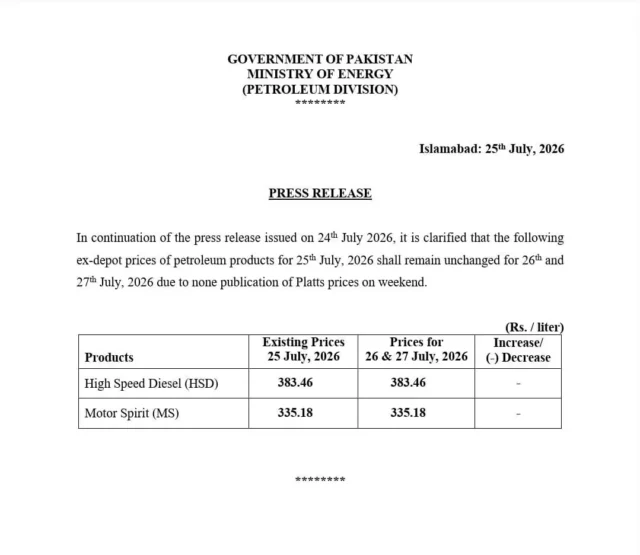
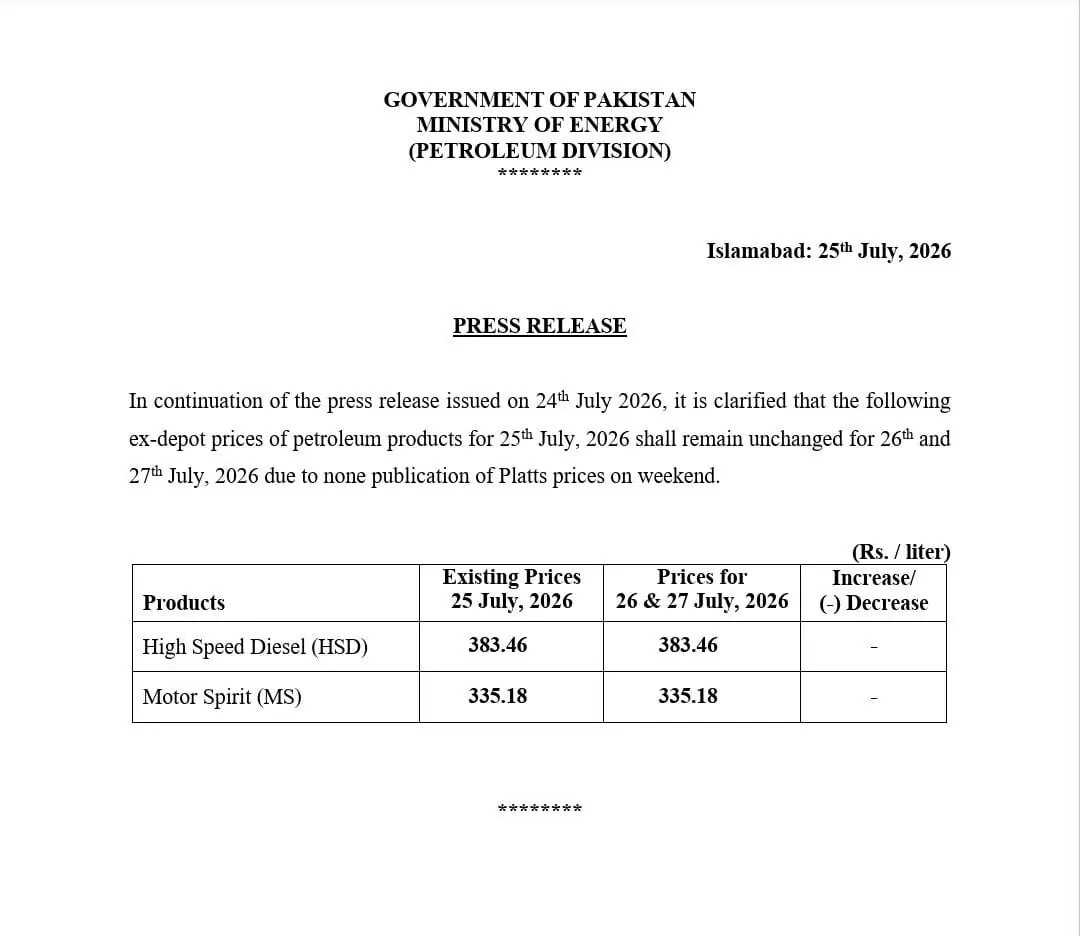
The government on Saturday kept the prices of petrol and high-speed diesel unchanged for July 26 and 27 due to the non-publication of “Platts prices on weekends”.
A day earlier, the prices of petrol and high-speed diesel (HSD) were increased by Rs3.66 and Rs4.80 per litre, respectively.
The current price of petrol stands at Rs335.18 per litre, while HSD is priced at Rs383.46 per litre. The government is charging a total of Rs110 per litre in taxes and duties on petrol and Rs96 on diesel.
The Petroleum Division’s notification said the price increase announced for July 25 would also remain applicable on July 26 and 27.
The diesel price has come down from a peak of Rs520.35 recorded on April 3. Its price had started rising from Rs281 per litre after the US-Iran war broke out on February 28.
The petrol price had peaked at Rs458.41 on April 3 after beginning its upward trajectory from Rs266 in the first week of March.
Earlier, Petroleum Minister Ali Pervaiz Malik announced that fuel prices would now be fixed on a daily basis due to fluctuations in international market prices following renewed hostilities between Iran and the US.
The government had been announcing weekly revisions to fuel prices since early March, alongside measures for the conservation of fuel amid possible oil supply disruptions due to the ongoing conflict in the Middle East. The federal government in April also announced targeted relief measures to provide subsidised fuel.
The petroleum minister stated that the cabinet and the prime minister had decided to give the Oil and Gas Regulatory Authority (Ogra) the responsibility of deciding fuel prices on a daily basis based on international market trends.
The daily pricing decision was rejected by the All Pakistan Dealers Association, which said it would consider a protest plan this week.
Petrol is mainly used in private transport, small vehicles, rickshaws and two-wheelers, and changes in its price affect the middle and lower-middle classes.
Similarly, changes in diesel prices also impact the public at large, as it is mainly used in the heavy transport sector, power plants and large generators.
Petrol and high-speed diesel (HSD) are the major revenue earners, with monthly sales of about 700,000 to 800,000 tonnes, compared to just 10,000 tonnes of monthly demand for kerosene.
Mr. Jackson, a progressive former State Senate president, clinched the nomination at a hastily arranged state party convention.
The Cockroach Janta Party called an end to weeks of protests after the education minister resigned, a win for that movement even as deep-seated anger among young people remains.
President Trump gave the keynote speech as relations between his administration and the press continue to deteriorate.
Firefighters were racing to contain blazes that were moving closer to Madrid and Bordeaux.
Some of the young demonstrators who forced out the country’s education minister described their deep-seated anger, frustration and desires that drove them into the streets.
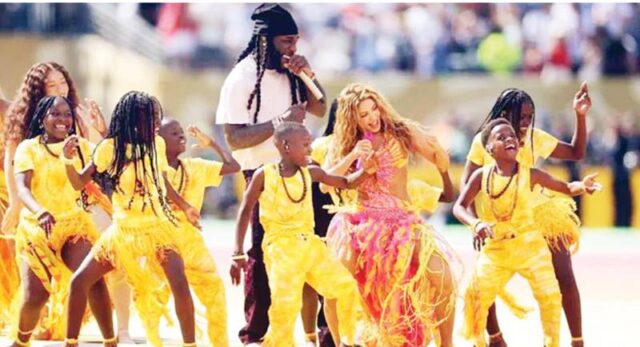

KAMPALA – Ugandan dance group the Ghetto Kids are celebrating another milestone after appearing at the football World Cup final half-time show on Sunday – a life-changing experience summed up by 10-year-old Sierra as “very, very, very, very, very good”. Despite critics bemoaning the addition of a Superbowl-style performance to the beautiful game’s biggest event, the children’s performance alongside global stars Burna Boy and Shakira was viewed by many millions around the world.
Speaking to the BBC’s Newsday programme, the young members of the dance troupe and their manager say that rising from humble beginnings in Uganda’s capital, Kampala, then finding fame while balancing it all with schoolwork has taken perseverance. “Never give up… pray to God. Listen to your parents, education is first, that’s all,” says Sierra. She and 11-year-old Josephine are still on a high, after their World Cup appearance midway through the game that saw Spain beat Argentina at the MetLife Stadium in New Jersey. “I saw Messi and Lamine Yamal!” says Josephine about the two team’s stars – Argentinian captain Lionel Messi and Spain’s teenage winger Yamal.
“I was so happy to see Messi and people watching us. I felt so excited and I was smiling, and a little bit nervous,” she recalls.
“Shakira, she’s very kind,” chimes in Sierra. The children gave Colombian pop star Shakira and Nigerian musician Burna Boy a big hug on stage as their performance ended – a moment their manager, Dauda Kavuma, insists was a natural show of affection, rather than clever choreography. Learning they had been picked to perform was a dream come true. The children “ran around in a circle, banging and shouting” when they learned the news, says Kavuma.
“They had already danced to Waka Waka in Britain’s Got Talent,” he explains about Shakira’s remake of the 1980s Cameroonian classic Zangaléwa by Golden Sounds. “But it was now a great moment to see that Shakira invited us… to perform with her. “It means a lot and it’s life-changing.” Kavuma’s philosophy is that there is so much talent in the ghetto, you just have to polish it. As a child he lived on the streets of Uganda’s capital before the kindness of a teacher changed his life. He wanted to give back and later became a teacher himself before creating the Ghetto Kids dance troupe – formed of homeless children and those who could not afford school fees. Combining a multitude of African dance styles, comedy and pure joy, they soon caught the attention of Ugandan musicians including Eddy Kenzo, who asked them to feature in some of his videos. The group’s strategy has involved harnessing the viral-making powers of the internet, and their biggest break followed in 2017 when they appeared in the music video for French Montana’s song Unforgettable – which at the time of writing has amassed more than 1.9 billion views on YouTube.
That recognition opened yet more doors, leading the Ghetto Kids to the final of Britain’s Got Talent in 2023, before also competing in America’s Got Talent the following year. It has also enabled Kavuma to expand his project offering housing, food and tuition to many children across Uganda.
This year’s football World Cup final may have been the Ghetto Kids’ biggest stage yet, but it was not their first major sporting event.
Back in 2023, the Ghetto Kids were thrilled to meet Kylian Mbappé and perform at a football half-time match in France between rivals Paris Saint-Germain and Reims.
Another recent career highlight was a film being made about their story, called Ghetto Kids Documentary: No Plan B. Despite their fame, the children’s parents and manager have instilled in them an “education-first” mentality. Videos for their vast social media following are filmed at weekends, so that weekdays are largely kept free for school, Kavuma says. If they have to travel for performances, the children connect online to their teachers while away and catch up on any missed work once back in Kampala.
Both Sierra and Josephine tell the BBC they plan to become doctors when they grow up but will never give up their passion for dance.
“Dancing changed my life – I went to school because of dance,” says Sierra.
Josephine agrees: “Dance is what I know and that makes me happy because that’s my talent.” So, what do they want to say to other children who, like them, might be talented but have not had the easiest start in life?
“To love themselves, believe in God, and pray. Be with their talents – don’t deny them,” answers Josephine.
“And we love them.”
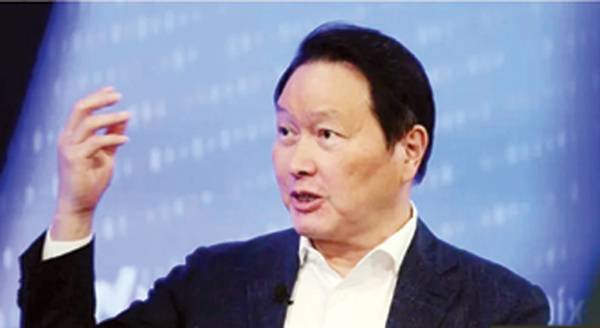

SEOUL – The chairman of corporate giant SK Group has been ordered by a South Korean court to pay his ex-wife 944bn won (£483m; $644m) in a case that local media has called the “divorce of the century”. The award, which still needs to be finalised, is below the initial 1.38tn won that chairman Chey Tae-won was told to pay Roh Soh-yeong in 2024. It comes more than a decade after his marriage to Roh – the daughter of a former president – fell apart following the revelation he had fathered a child with another woman. SK Group runs SK Hynix, the semiconductor giant that supplies chips to Nvidia and recently made a record-setting debut on the US stock market. Chey’s lawyers said “Chairman Chey Tae-won is deeply sorry in that [the divorce] proceedings so far have caused concern to many people. We will share specific response to the verdict after we closely review the ruling.”
SK Group is one of South Korea’s chaebols – family-owned conglomerates that dominate the country’s economy. The verdict comes after deliberation over the division of assets between Roh and Chey, who had been married for 35 years.
During the earlier trial in 2024, Roh’s legal team had successfully argued that Chey had received significant help from his ex-wife’s father, Roh Tae-woo, who had served as the country’s president between 1988 to 1993. The court had determined that the strongman had given Chey 30bn Korean won from his slush fund in 1991, and told Chey to pay 1.38tn to his ex-wife. But the Supreme Court overturned the verdict last year, ruling that the slush funds were illegally obtained and could not be considered as part of the couple’s assets. The case has gripped South Korea. SK Group began as a textile company in 1953 but quickly grew across a wide swath of industries to become one of South Korea’s biggest conglomerates. Today, it is the second largest chaebol after the Samsung group. South Korean people buy phone plans from SK Telecom and fill their vehicles at SK petrol stations. The group gained global prominence after its subsidiary SK Hynix found itself at the centre of the artificial intelligence (AI) boom. In May, the chipmaker surpassed $1tn (£750bn) on the South Korean stock market.
As SK Hynix’s value soared, the SK Group and its chairman Chey’s status also rose. Last month, President Lee Jae Myung commended Chey during the unveiling of a landmark AI investment plan, calling him and Samsung chairman JY Lee “Heroes of Korean People.” The company also raised $26.5bn in its New York share offering, marking the largest ever listing by a foreign firm in the US.
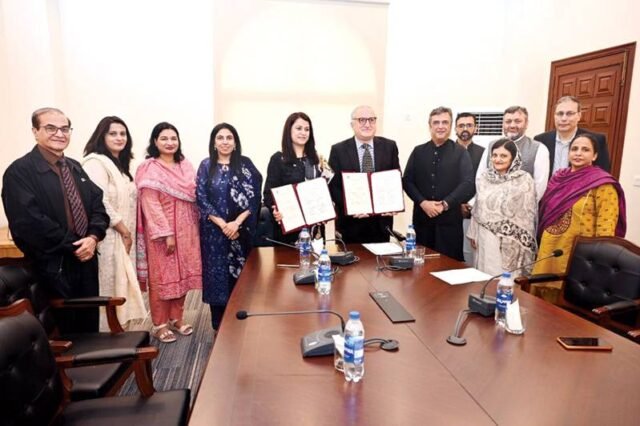

LAHORE – The National School of Public Policy (NSPP) signed a Memorandum of Understanding (MoU) with Kinnaird College for Women University, Lahore, to strengthen collaboration in public policy research, publications and joint academic activities. The ceremony began with the welcome address by Dr Naveed Elahi, Dean, National Institute of Public Policy (NIPP). He briefly introduced NSPP’s integral and constituent units — the National Institute of Public Policy, the Administrative Staff College and the National Institutes of Public Policy (NIPAs) and shared the Rector’s vision of building strong linkages with the country’s most prestigious academic institutions. He said the greatest dividend of the MoU would be the interaction it opens up with the youth of Kinnaird College. Rector NSPP, Farhan Aziz Khawaja, said the partnership would create new opportunities for joint research, faculty interaction, seminars, internships and capacity building, adding that students who engage early with real policy problems develop a lasting sense of public purpose. Prof Dr Iram Anjum, Principal, Kinnaird College, said the collaboration marked an important step towards bridging academic research and policy practice, giving faculty and students the chance to learn from real policy challenges. The MoU was signed by the Rector and the Principal on behalf of their respective institutions. Senior representatives of both institutions attended the ceremony.