








Why there is no lawyers’ movement in Pakistan today – Pakistan
In 2007, live television turned a sacked chief justice into a national uprising that ended Gen Musharraf’s rule. A lawyer who marched then, and resigned from the Supreme Court in protest last year, explains why that isn’t happening now.
The Lawyers’ Movement of 2007-2009 is considered one of the most significant episodes of civic mobilisation in the country’s history. What began as a dispute over the suspension of the chief justice of Pakistan evolved into a nationwide campaign to challenge Gen Musharraf’s rule
The reinstatement of a handful of deposed judges was symbolic. Its true importance lay in restoring the Constitution, ending a decade of dictatorship, facilitating the return to democratic governance, and reaffirming the principle that political authority must derive from the will of the people, rather than from unelected centres of power.
The conventional explanation given for the movement’s success focuses on lawyers, judges, and political parties. All three groups played a role, but this reasoning overlooks a fundamental factor: the movement’s ability to transform a constitutional dispute into a compelling national narrative.
Understanding why that happened explains why no comparable lawyers’ movement exists today, despite continuing debates about constitutionalism, judicial independence, and the rule of law.
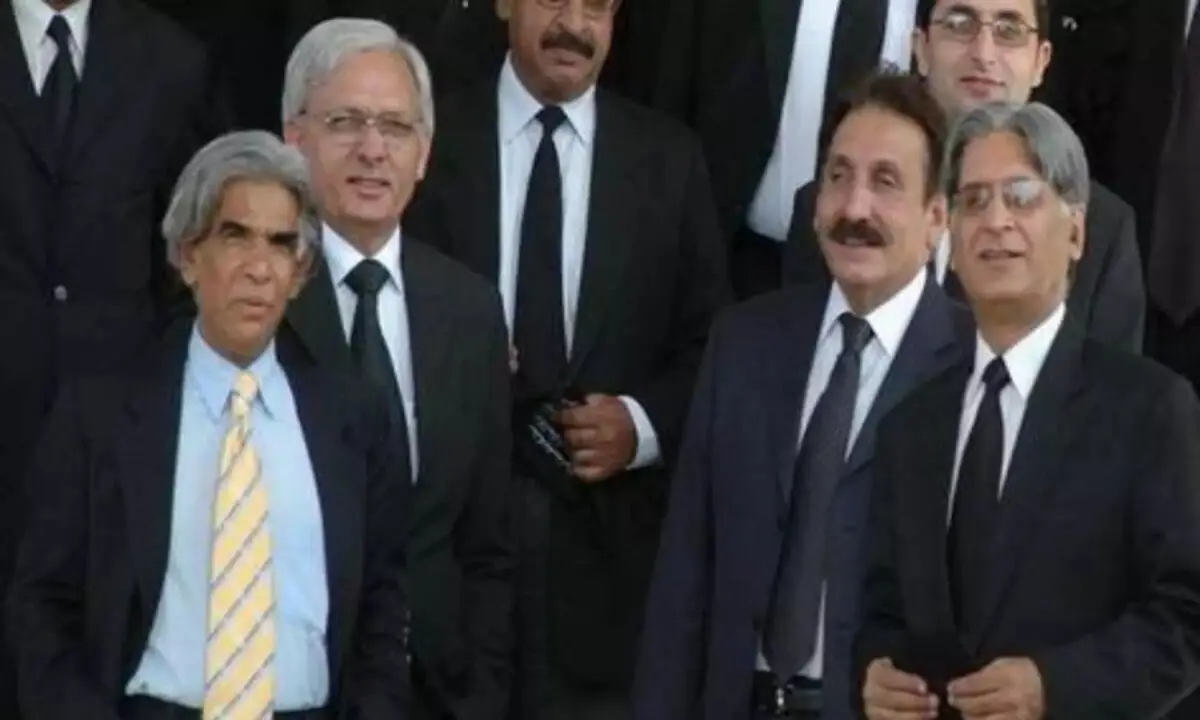
When it began, of course, the 2007 Lawyers’ Movement was hardly a mass uprising. In those days most Pakistanis had little direct engagement with judicial politics. The turning point came when private television channels began providing continuous live coverage of protests, court proceedings, and political developments. For days, weeks, and months, prominent lawyers such as Aitzaz Ahsan, Muneer Malik, Hamid Khan, Tariq Mehmud, and Ali Ahmad Kurd addressed audiences live on television, openly challenging the authority of Gen Pervez Musharraf, who simultaneously held the offices of president and chief of army staff. He had underestimated the impact of live visuals.
This was unprecedented. Millions of Pakistanis watched lawyers criticise the country’s most powerful institutions in realtime. Rallies, arrests, police actions, and courtroom developments were broadcast live, transforming what might otherwise have remained a professional dispute on a national political cause.
The significance of this media environment cannot be overstated. Political movements succeed not simply because grievances exist, but because they become visible, shared, and emotionally resonant. Live television allowed citizens to witness events as they unfolded, turning isolated protests into a national conversation. Images of the chief justice being manhandled by police, unarmed lawyers in their black coats resisting arrest, the violence in Karachi on May 12, 2007, and, later that same evening, Gen Musharraf displaying his arrogance by raising his fists and declaring victory, transformed a constitutional dispute into a moral drama that was beamed into millions of living rooms.
An often-overlooked aspect of the movement is that, in its initial months, the judiciary itself did not immediately emerge as a united institution of resistance. Following the chief justice’s suspension in March 2007, judges continued functioning within the existing judicial framework. Between March and November, however, the movement gathered extraordinary momentum through relentless media coverage and sustained public mobilisation. Twenty-four-hour television transformed lawyers into national figures and judicial independence into the defining constitutional issue of the day. As public support intensified, judges increasingly found themselves at the centre of a national constitutional struggle. When emergency rule was imposed in November 2007 and judges were required to take the oath under the Provisional Constitutional Order, many refused. By then, they understood that they would be seen as villains if they joined the other side.
The movement also arrived at a particular time within the broader political context. By 2007, Pakistan had experienced almost a decade of Gen Musharraf’s rule, for which public fatigue had become increasingly evident. Many Pakistanis, irrespective of political affiliation, were thus receptive to demands for constitutional restoration and democratic change. Gen Musharraf had also largely lost the support of key foreign allies, many of whom appeared to believe that their principal strategic interests had already been secured.
A further important factor was the alignment of political parties. All major political parties eventually converged on a shared minimum demand: restoration of the judiciary and genuine democracy. Their common objective of restoring democracy transformed what began as a professional protest into a broad constitutional movement and greatly facilitated mass mobilisation. The violence of May 12, 2007 and its visuals telecast live further alienated the few political parties that continued to support Gen Musharraf, deepening his political isolation.
Today, the political landscape is markedly different. Except for one major political party, most others are perceived to have accommodated themselves to prevailing centres of power, weakening their capacity to serve as independent drivers of constitutional and democratic mobilisation. The principal opposition party, despite commanding substantial public support, is widely seen as politically and organisationally constrained. Its leadership remains incarcerated, its organisational structure fragmented, and its ability to act as a unifying national force significantly diminished. There is a widespread perception that recent constitutional and legal changes, including the 26th and 27th Amendments, have further strengthened the coercive apparatus. Unlike in 2007–09, there is no unified political front capable of reinforcing or amplifying a nationwide constitutional movement.
Youth and young lawyers also played a critical role. Senior leaders themselves were committed and led by the idealism of the young, whose determination discouraged compromise at crucial moments. Thousands of younger lawyers organised rallies, travelled across cities, and maintained the movement’s momentum for nearly two years. Effective movements require leadership, but they also depend upon committed participants willing to assume personal risk.
Equally important was the culture of the legal profession. Before the Lawyers’ Movement, bar associations functioned differently. Although elections were contested, they were generally fought over professional integrity, institutional independence, and the welfare of the legal profession rather than overt partisan loyalties. The organised bar retained a strong institutional identity rooted in constitutionalism and the defence of judicial independence.
The establishment had also not regarded the organised legal profession as a significant political challenge. Consequently, it had made relatively few inroads into the internal politics of bar associations. When the confrontation over the judiciary emerged, the bars were therefore able to respond with unusual unity and institutional coherence.
Slogans amplified mobilisation. Demands such as Dastoor ki baladasti (supremacy of the Constitution) and Adliya ki bahali (restoration of the judiciary) were accompanied by more emotive expressions such as Riyasat hogi maa ke jaisi (the state will be like a mother). Crowds openly chanted slogans directed at the dictator’s regime, and these scenes were broadcast live by private television channels into millions of homes. The fact that such slogans could be aired live on national television was itself extraordinary. Together, these broadcasts transformed constitutional language, political dissent, and public protest into a vocabulary that ordinary citizens could understand, identify with, and embrace.
The movement combined grievance with hope. While opposing undemocratic rule, it presented an aspirational vision of justice, constitutionalism, and dignity. That combination enabled it to resonate far beyond lawyers and political elites.
The absence of a comparable lawyers’ movement today reflects the disappearance of many of these conditions. Contemporary Pakistan differs fundamentally from the environment that existed between 2007 and 2009.
The most obvious difference is the media landscape. During the movement, private television channels powerfully amplified dissent. The same channels that broadcast lengthy speeches against a sitting general and provided uninterrupted coverage of anti-establishment protests are now widely perceived to operate within much narrower limits.
Whether due to formal restrictions, informal pressures, commercial considerations, or self-censorship, sustained live broadcasts openly challenging powerful institutions have become almost unimaginable on mainstream private television. Equally important is the perception that the media’s institutional role has changed. During the lawyers movement, many journalists regarded themselves as participants in a broader struggle for constitutionalism and media freedom. Today, that visible institutional resistance is far less apparent. The institution that once helped construct a national narrative of resistance is now widely seen as less able to perform that function.
This matters because movements depend upon visibility. Without shared public exposure, grievances remain fragmented and rarely develop into collective causes.
A climate of fear has increased the perceived cost of mobilisation. Reports of pressure, restrictions on dissent, and intimidation have reinforced the perception that political participation carries greater personal risk, making collective action considerably more difficult. The authority meant to serve the people is instead perceived as being used to silence them.
The legal profession has also undergone profound change. The unity that once characterised the bar associations is no longer evident. Many observers argue that bar politics has become increasingly shaped by partisan affiliations and factional interests rather than shared institutional principles. Over the past two decades, the establishment has also had considerably more opportunity to cultivate influence within a range of institutions, including segments of the legal profession.
Perhaps the most significant change lies within the bars themselves. It is no secret that many lawyers privately acknowledge what they regard as a serious erosion of the rule of law and judicial independence. Many believe that the judiciary has become increasingly subject to the influence of unelected power centres, often acting through the constitutional façade of an elected parliament. Yet these concerns have rarely translated into sustained institutional resistance. Instead, there appears to be a degree of resignation — and, in some quarters, tacit acceptance — that this is now the prevailing constitutional order. The reality may be widely understood within the profession, but few institutional voices are prepared to challenge it publicly.
Cases involving lawyers such as Imaan Mazari and Hadi Ali Chattha are frequently cited in this context. The muted response from representative legal bodies manifests the difference between today and the collective activism displayed during the Lawyers’ Movement.
There is another, perhaps more ironic, reason why the public is reluctant to place the same trust in judges and lawyers today. The success of the Movement raised immense public expectations that the restored judges and lawyers would fulfil their promise of making the Riyasat like a mother for its people. Regrettably, many believe those expectations were not met. The judges and lawyers became the principal beneficiaries of a struggle sustained by the sacrifices of ordinary citizens. The ninety innocent lives lost during the movement were gradually forgotten, while the idealism of countless young lawyers was left frustrated.
Instead of using the opportunity to transform the justice system, particularly at the district level where ordinary citizens seek justice, the restored judiciary was widely perceived to have reverted to many of the same institutional practices that had existed before the movement. Genuine reform, made possible by the extraordinary public support for the judiciary, never materialised. For the common citizen, little changed. That disappointment has inevitably weakened public trust in both judges and lawyers.
The broader lesson extends beyond Pakistan. Political movements are rarely driven by facts alone. They depend upon narrative, visibility, organisational cohesion, favourable political conditions, and emotional resonance. The Lawyers’ Movement succeeded not simply because lawyers protested or judges were restored, but because it transformed judicial independence from an abstract legal issue into a compelling national story that millions of Pakistanis could identify with.
Today, nearly every condition that made that transformation possible has changed. The media no longer possesses the same freedom to amplify dissent, bar associations are more fragmented and increasingly shaped by partisan politics, collective institutional resistance has weakened, and political parties no longer provide a unified constitutional platform. Constitutional concerns remain, but the institutional and political ecosystem that once transformed those concerns into a nationwide movement no longer exists.
Throughout history, lasting constitutional transformation has been brought about by political leadership rather than by judges or generals. The Lawyers’ Movement was never merely about restoring a handful of judges to office. Its larger purpose was the restoration of the Constitution, democracy, and the principle that the will of the people must prevail.
It was the political leadership—not judges or lawyers—that ultimately had to make the Constitution work in letter and spirit. For more than seven decades, Pakistan has witnessed repeated cycles in which political leaders aligned themselves with centres of power, celebrating when their opponents became victims, only to forget their own persecution when they later returned to office with the support of those very centres of power. In the end, it has always been the will of the people that has suffered.
The Lawyers’ Movement succeeded because, at that historic moment, political leadership demonstrated the resolve to honour the Charter of Democracy. That spirit created the possibility of building a state that cared for every citizen, especially the weakest and most vulnerable.
The success of the Lawyers’ Movement is too often measured by the restoration of the deposed judges rather than by its far greater achievement: ending nearly a decade of Gen Musharraf’s rule and paving the way for the restoration of constitutional democracy through a freely elected parliament after the unprecedented mass mobilisation that culminated in the 2008 general elections. The reinstatement of the judges was largely symbolic. Ironically, the restored judges were later widely perceived as contributing to the weakening of the very parliament that represented the movement’s greatest constitutional success. That role, however, deserves separate discussion.
Today, the reality is widely recognised. Regrettably, political leaders who have sworn to preserve, protect, and defend the Constitution now openly take pride in governance through a hybrid system rather than under the Constitution itself. The greatest responsibility, therefore, rests with the political leadership because it has voluntarily assumed the duty of leading the nation.
What Pakistan needs today is not another Lawyers’ Movement but the collective spirit that once united political leaders, judges, lawyers, journalists, the media, civil society, and ordinary citizens. It needs a movement to make the Riyasat a mother for every citizen, to break the shackles of elite capture, restore the supremacy of the Constitution, and ensure that the will of the people alone governs the country.
It is time for truth and reconciliation. The choice is clear: continue repeating the failures of the past, or finally learn from our mistakes, honour the constitutional promise made to the people, and build a state governed, in both letter and spirit, by the will of its actual stakeholders — the people.