Bills

Home Bills Page 65

Israel warns Hamas over kite launches from Gaza

0


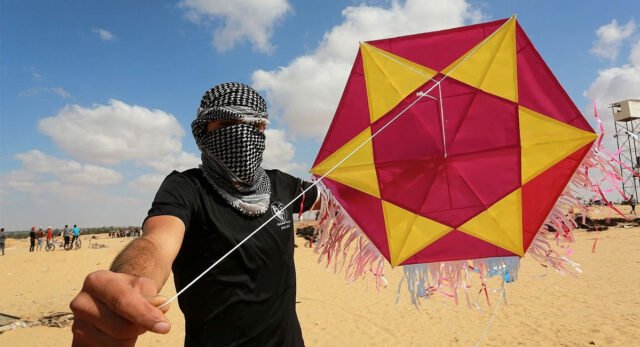
Jerusalem, Undefined: Israel warned Hamas on Sunday that it would step up operations in Gaza if launches of kites, drones and balloons towards Israel continued, after a recent increase in such incidents, while Hamas denied responsibility.

Israeli media reported that four kites were found in communities near the Gaza border on Saturday and one was shot down by the army on Sunday, bringing the total number recovered in recent days to around 10.

The incidents have revived memories of waves of incendiary kites and balloons launched from Gaza in previous years, which sparked fires in agricultural lands in southern Israel.

According to the reports, the Israeli military believes Hamas was behind the launches, which did not carry explosives, and may have been testing how Israel would respond.

“Israel warns Hamas that if the launches toward Israel do not cease immediately, the IDF will take action to intensify targeted operations against those responsible… and will evacuate the population from areas from which kites, drones and balloons are launched,” Prime Minister Benjamin Netanyahu and Defence Minister Israel Katz said in a joint statement.

They said they had held a security assessment with top military and security officials on Sunday to discuss the matter.

Uri Epstein, a leader for Gaza border communities — many of which were attacked by Hamas on October 7, 2023 — told Channel 12 that “after October 7, we will no longer tolerate the words ‘It will be ok’”.

Read Also: Israeli airstrikes in Gaza kill two people, including a 4-year-old boy, medics say

“The writing is in the sky, and it’s the army’s responsibility to act in time.”

Hamas meanwhile denied responsibility for the launches.

Bassem Naim, a member of Hamas’s political bureau, said in a statement that the kites were “launched from Gaza by children searching for their innocent childhood amid the rubble”.

In a separate statement, the Islamist group accused Israel of using the kites as a “pretext” for airstrikes in central Gaza on Sunday, in which three people were killed according to Gaza’s civil defence rescue service.

Pakistan lose Najiha Alvi ahead of ACC Women’s Asia Cup

0


Pakistan suffered a major blow ahead of the ACC Women’s T20 Asia Cup as wicketkeeper-batter Najiha Alvi has been ruled out of the tournament due to injury, with right-handed batter Sadaf Shamas named in the squad as her replacement.

The Pakistan Cricket Board (PCB) confirmed on Monday that Najiha reported pain in her posterior left knee, while later the scans revealed a possible sprain in it.

Following an assessment by the PCB’s medical team, Najiha is set to begin her rehabilitation programme immediately, which is expected to last up to four weeks.

The national women’s selection committee added Sadaf to the Asia Cup squad. She has played 12 WT20Is so far after making her debut in January 2023.

The eight-team Women’s Asia Cup is set to be played from 28 August to 13 September at the Dubai International Cricket Stadium, with all 15 matches beginning at 7.30pm PKT.

Pakistan are placed in Group A alongside Hong Kong, India and Thailand. Group B consists of Bangladesh, Indonesia, Sri Lanka and United Arab Emirates.

Pakistan will face Thailand on 1 September, India on 5 September, and Hong Kong on 7 September, while the semi-finals will take place on 10 and 11 September. The final is scheduled for Sunday, 13 September.


AIPAC Wants to Back This Republican, but He Has Some Reservations

0


The pro-Israel group has been preparing to spend big for Mike Rogers, the Republican nominee for Senate in Michigan. Does he want that?

President hails outgoing Saudi envoy’s contribution to boost Pakistan-Saudi ties

0


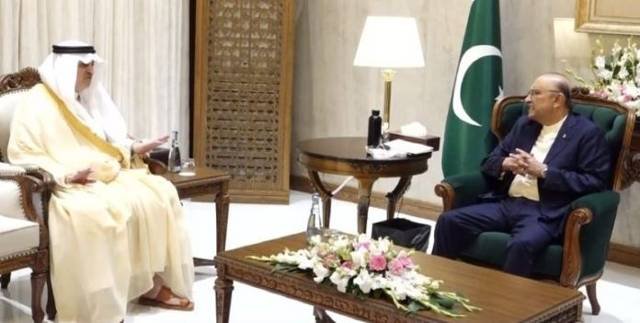
Islamabad  –  President Asif Ali Zardari has appreciated the contribution of Ambassador of the Kingdom of Saudi Arabia to Pakistan, Nawaf bin Said Al-Malkiy, towards strengthening the longstanding fraternal and strategic ties between Pakistan and Saudi Arabia. The President said this while talking to Ambassador Nawaf bin Said Al-Malkiy who called on him for a farewell call at Aiwan-e-Sadr.

The President expressed appreciation for his dedicated service and the friendship, warmth and cooperation he extended to Pakistan during his tenure. He said the Ambassador had played an important role in advancing bilateral relations, particularly in the political, economic and trade spheres.

The President said Pakistan deeply values its time-tested friendship and strategic partnership with Saudi Arabia and appreciated the Kingdom’s steadfast support for Pakistan. He also expressed confidence that the strong foundation laid during Ambassador Nawaf’s tenure would continue to guide bilateral cooperation in the years ahead.

Ambassador Nawaf bin Said Al-Malkiy, who has served as Saudi Arabia’s Ambassador to Pakistan since 2017, thanked the President and the government and people of Pakistan for the warmth and cooperation extended to him during his stay in the country. He said he would continue to hold Pakistan and its people in high regard.

The President wished Ambassador Nawaf bin Said Al-Malkiy success and the very best for his future endeavours, saying that Pakistan would always remain his second home. Senator Sherry Rehman was also present during the meeting.

Trump’s Economic Approach Draws Concern From Some Republicans

0


A plan to lower tariffs on imported beef and trade tensions with Canada have compounded some G.O.P. worries about a central issue in the midterms.

French Tourist Dies in Death Valley During 116-Degree Heat

0


The 68-year-old tourist and his companion were driving through Death Valley National Park on a remote road last week when their car got stuck in mud, officials said.

Why peace has become an economic necessity

0


The world is entering one of the most uncertain periods of the modern era. The COVID-19 pandemic, global cost-of-living crisis, Russia-Ukraine war, growing geopolitical rivalry and renewed conflict in the Middle East have weakened economic resilience. In many cases, one crisis has struck before the world could recover from the previous one.

The central question is therefore no longer simply who will win a particular war, but whether the international community can prevent geopolitical confrontation from turning into a global economic and humanitarian catastrophe.

The latest Middle East conflict has again demonstrated the interconnectedness of the global economy. Energy markets, shipping routes, food prices, inflation, financial markets and international trade are closely linked. A disruption thousands of kilometres away can quickly affect households and businesses around the world.

The International Monetary Fund’s July 2026 World Economic Outlook projects global growth of 3.0 percent in 2026 and 3.4 percent in 2027. However, it warns that global disinflation has stalled and that the outlook remains vulnerable to renewed conflict and financial-market repricing. Global inflation had already reached almost 9.5 percent in 2022, while the pandemic and geopolitical tensions disrupted supply chains and increased living costs.

Energy remains at the centre of this vulnerability. Around one-fifth of global oil consumption normally passes through the Strait of Hormuz, making any disruption there a serious threat to international energy security. Alternative supplies, inventories and weaker demand can cushion the impact, but these buffers are limited.

For energy-importing developing countries, higher oil prices mean much more than expensive petrol. They increase transportation, electricity and production costs and ultimately push up food prices. Countries with weak currencies, high external debt and limited foreign-exchange reserves are particularly vulnerable.

Europe is also exposed. The IMF projects euro-area growth of only 0.9 percent in 2026 and 1.2 percent in 2027, while UK growth is forecast at 1.0 percent in 2026 and 1.3 percent in 2027. These figures do not indicate economic collapse, but they show how vulnerable slow-growing economies can become to another major shock.

Developing countries face the greatest risks. Higher energy and food prices can fuel inflation, weaken currencies, widen fiscal deficits and make external debt harder to service. A commodity-price shock can therefore trigger a chain reaction—from an energy crisis to inflation, debt distress, food insecurity and humanitarian suffering.

At the same time, the international order is becoming increasingly fragmented. Trade, technology, energy and investment are being shaped by strategic rivalry. More than 10,000 trade-distorting industrial-policy interventions were recorded globally between 2023 and 2025. Such fragmentation creates uncertainty, particularly for smaller economies dependent on international markets, investment and technology.

Major powers must therefore assume greater responsibility. The United States and China have a shared interest in preventing prolonged global instability despite their rivalry. The United Nations needs a stronger diplomatic role, while Europe and other powers should support meaningful negotiations over Ukraine. Regional powers must work towards de-escalation in the Middle East, alongside renewed efforts for a durable Israel-Palestine settlement.

Peace is no longer merely a moral objective; it is an economic necessity. Stable energy markets, investment, trade routes and sustainable development all depend on peace.

The world needs a new international compact centred on peace, economic resilience and cooperation. Geopolitical victories may be temporary, but the economic and human costs of conflict can last for generations.

Humanity has already suffered enough from pandemics, wars, displacement and economic uncertainty. The choice is increasingly clear: cooperation or fragmentation, diplomacy or escalation, economic stability or humanitarian suffering.

The world still has an opportunity to choose peace before the cost of another conflict becomes greater than it can afford. The writer is a faculty member at National Skills University Islamabad

Professor Nadeem Iqbal of National Skills University Islamabad can be reached at nadeem.iqbal@nsu.edu.pk and Drnadeemiqbal1@gmail.com


The Price of Bread

0


War, climate shocks and trade disputes are pounding the world’s breadbaskets and pushing the global food system into dangerous territory.

Alibaba launches $10 billion Hong Kong share placement to fund AI spending

0


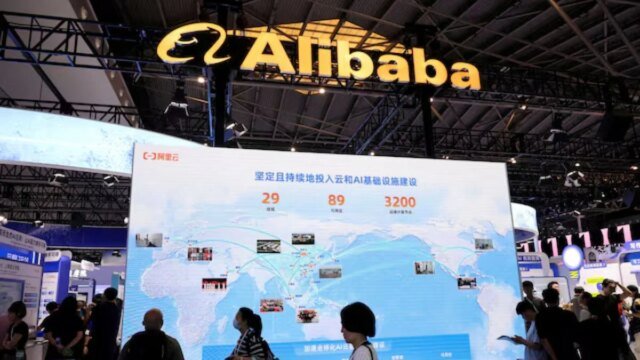
China’s Alibaba on Sunday launched a HK$80-billion ($10.2 billion) ​share placement to fund artificial intelligence-related development.

A deal by the Chinese e-commerce and cloud computing giant would ‌mark the largest-ever primary follow-on offering by a Hong Kong-listed company.

It would rank as the world’s third-largest primary follow-on share sale this year after offerings from Alphabet and Intel.

The company said it intends to use 100% of the net proceeds from the placement to invest in ​its “full stack” AI capabilities, a category that includes chips, infrastructure and the development and deployment of AI models.

A ​term sheet reviewed by Reuters showed Alibaba planned to sell 710 million ordinary shares at ⁠HK$112.70 a share. That represented a 3.6% discount to its most recent closing price.

In its announcement for the $10.2 billion ​share placement, Alibaba did not reveal additional details on its investment plans by category of its planned AI-related investment.

It did ​not comment beyond its regulatory disclosure.

Last week, Alibaba reported its results for the April-to-June quarter, saying it had already spent nearly half of its three-year capex investment plan. It said its expected payback on AI-Alibaba increased the size of the offering after the deal was oversubscribed, ​the people familiar with the ​matter said.

Morgan Stanley, HSBC, UBS ⁠and CICC are serving as joint bookrunners of the Alibaba offering, said one of the sources and a third person with knowledge of the matter. The banks did not ​immediately respond to a Reuters request for comment.

The share placement was not registered under ​U.S. securities laws ⁠as an offshore transaction, meaning American investors were not eligible to participate, Alibaba said.

Since 2022, the global AI boom has fuelled staggering capital outlays on infrastructure and data centers, including in the U.S. and China.

The four major U.S. hyperscalers – Microsoft, Amazon, ⁠Alphabet and ​Meta- together are expected to spend roughly $725 billion in capital expenditures in ​2026, much of it tied to AI data centers, chips and cloud infrastructure.related investments was on track to fall to 2.5 years from ​3 years, driven by surging demand.

Alibaba’s net profit for the quarter fell 75% from a year earlier as it ramped ​up its AI-related capital expenditures.

“In order to be able to capture that future growth, we first need to make these capex investments ‌to ⁠build out the necessary compute capacity,” CEO Eddie Wu said on an earnings call.

The company’s share offering has been met with strong demand from investors, including sovereign wealth funds, two people familiar with the deal told Reuters. They could not be named because the information was not public.

Social Alienation

0


Franz Kafka’s novella The Metamorphosis explores social and economic alienation, a theme that remains strikingly relevant in Pakistan today.

In the story, Gregor Samsa awakens transformed into a strange creature and gradually becomes a burden to his family because he can no longer earn a living. Sadly, this fictional tragedy mirrors the experiences of many people in Pakistan. Unemployment, inflation, rising utility bills and limited job opportunities have left countless hardworking citizens struggling to support their families. When a person’s income disappears, respect and social standing often vanish with it.

Many educated graduates remain unemployed despite years of study, while salaried workers find it increasingly difficult to cope with the rising cost of living. Those who lose their jobs because of illness, disability or economic hardship frequently encounter neglect rather than compassion, leaving them isolated and emotionally exhausted, much like Gregor Samsa.

Kafka’s novel reminds us that people should be valued for their humanity, not merely their economic worth. The government should create more employment opportunities, strengthen social welfare programmes and ensure fair wages so that fewer people experience the loneliness, exclusion and loss of dignity portrayed in The Metamorphosis.

MUHAMMAD AHMAD MUZAKKI,

Kasur.

Popular Posts

My Favorites