Bills

Home Bills Page 8

Pakistan will go to any length to defend Saudi Arabia: DG ISPR

0


Pakistan will go to any length to defend Saudi Arabia, while its commitment to the kingdom’s security and the protection of Haramain Sharifain remains unconditional, Director General Inter-Services Public Relations (DG ISPR) Lieutenant General Ahmed Sharif Chaudhry said in an interview with Arab News.

“There should be no ambiguity about Pakistan’s commitment to the security of Saudi Arabia and the protection of Makkah and Madinah,” the DG ISPR said, adding that Pakistan would continue to defend the kingdom against all forms of aggression.

He said Pakistan stood fully with Saudi Arabia and that the two countries were bound by a “historic and unbreakable” relationship involving their peoples, political leadership and armed forces.

Lieutenant General Ahmed Sharif said Pakistan remained committed to the pledges it had made to Saudi Arabia and was present to safeguard the security and sanctity of Haramain Sharifain.

He said the Makkah Joint Defence Agreement, signed by Pakistan, Saudi Arabia and Turkiye on August 7, stipulates that an armed attack against any one of the three countries would be considered an attack against all three.

The agreement also envisages enhanced defence cooperation among the three countries, he said, adding that in the event of an attack, the three sides would consult each other and decide on a course of action accordingly.

The DG ISPR said Pakistan’s political and military leadership remained in close contact with the Saudi leadership amid the current regional tensions. Islamabad was also continuing diplomatic efforts aimed at de-escalation and a peaceful resolution of the crisis through dialogue.

His remarks came as Saudi Arabia faces missile and drone attacks by the Houthis, according to the report. Pakistan has reiterated its commitment to Saudi security amid the recent attacks.

According to the official statement on the Makkah Joint Defence Agreement, the pact seeks to strengthen joint defence capabilities and collective deterrence against aggression targeting any of the three countries.

Rejecting Trump, South Korean Leader Says He Will Not Send Troops to Iran

0


President Lee Jae Myung’s comments followed President Trump’s repeated demand for “a little hand” from South Korea, a decades-old American ally.

Pakistan security forces kill 17 Fitna al-Khawarij, Hindustan in KP, Balochistan

0


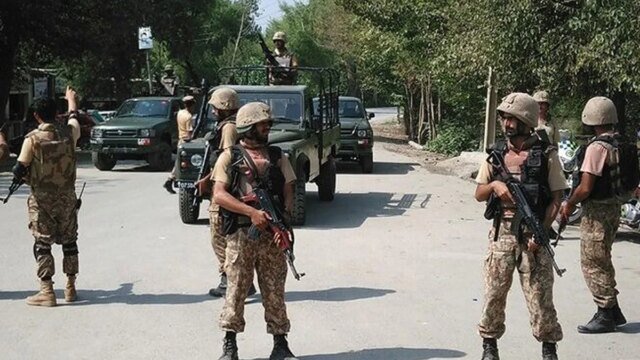
RAWALPINDI: Security forces have killed 17 Fitna al-Khawarij and Hindustan terrorists in separate intelligence-based operations in Khyber Pakhtunkhwa and Balochistan, according to the Inter-Services Public Relations (ISPR) and security sources.

According to ISPR, six security personnel were martyred on September 17 when an improvised explosive device (IED) detonated during an operation.

According to the military’s media wing, 10 terrorists were killed during separate operations in North Waziristan and Hangu. The ISPR said the terrorists belonged to the Tehreek-i-Taliban Pakistan-linked group referred to by authorities as Fitna al-Khawarij and alleged that they were operating with Indian support.


A large quantity of weapons and ammunition was also recovered from the militants, the ISPR said. Clearance operations are continuing in the areas to eliminate any remaining militants.

The ISPR said Operation Azm-e-Istehkam would continue until the elimination of what it described as foreign-sponsored terrorism. It paid tribute to the security personnel who lost their lives, saying their sacrifices further strengthened the resolve to defend the country.

Meanwhile, security forces also continued operations against militants in Balochistan under Operation Radd-ul-Fitna 3.

According to security sources, seven terrorists belonging to Fitna al-Hindustan were killed in two separate operations.

Read more: Pakistan security forces ‘kill’ three terrorists in Balochistan

Five terrorists were killed in the Fateh Ali area of Panjgur, where a large quantity of weapons and ammunition was also recovered, the sources said.


In another intelligence-based operation in the Dhadar area of Kachhi district, security forces killed two terrorists . Several others were also reported to have been wounded in the operation, according to security sources.

Security forces are continuing operations aimed at eliminating terrorists and maintaining peace and security in the region.

On Thursday, Pakistan security forces killed three terrorists during an intelligence-based operation in Balochistan under Operation Radd-ul-Fitna 3, said sources.

As per details, the operation was carried out in Badrang area of Awaran district. The sources said a large quantity of weapons and ammunition was recovered from the militants, who were identified as members of Fitna al-Hindustan.

According to security sources, militants affiliated with the group have suffered significant losses during recent security operations in Balochistan.

Security forces remain committed to continuing operations against militants in the province until the threat of terrorism is eliminated, the sources said.

Japan’s central bank raises policy rate to 31-year high

0


The Bank of Japan raised interest rates to a more than 30-year high of 1.25 percent on Friday and said it would lift further as it looks to counter inflation fuelled by surging energy prices and a weak yen.

The hike was expected by the markets following the recent tightening by the European Central Bank and the US Federal Reserve.

The central bank’s decision to raise its key rate by 25 basis points was carried by a 7-2 majority vote, the BoJ said on its website.

Pressure has increased on officials to lift borrowing costs as a spike in oil prices caused by the Middle East crisis, which shows little sign of ending anytime soon, is expected to keep putting upward pressure on inflation.

Central bankers are also minded to support the yen, which fell in July to its weakest level against the dollar in 40 years, prompting a historic joint intervention in foreign exchange markets by the United States and Japan.

“As for the future conduct of monetary policy, given that underlying CPI inflation has been approaching two percent and financial conditions have been accommodative, the bank will continue to raise the policy interest rate,” the BoJ said.

Ahead of Friday’s decision, the yen softened to 156.23 per US dollar in early trading.

Japan’s Nikkei was 0.9% higher.

Asian stocks rose and the dollar held its ground against other currencies on Friday as investors contended with global policymakers ramping up efforts to rein in inflation, with a dip in oil prices improving sentiment.

MSCI’s broadest index of Asia-Pacific shares outside Japan rose 0.55%. The tech-heavy South Korea’s KOSPI surged 2%.

Hopes of alternate ways for oil supply from the Middle East to reach markets pushed Brent crude oil futures down 1% to $103.77 a barrel even as concerns about strikes between Saudi Arabia and Yemen’s Houthis lingered.

The euro was steady at $1.148, but on course for a 1% drop for the week, its biggest fall since June.

In commodities, spot gold rose 0.5% to $4,361 an ounce.

Hours before the BOJ’s rate decision, Japan released core consumer inflation data for August.

The numbers held steady near the central bank’s 2% target in August, highlighting mounting price pressures that solidify the case for an interest rate hike.

The core consumer price index (CPI), which excludes volatile fresh food prices but includes fuel costs, rose 1.7% in August from a year earlier, according to official data.

The increase was below the median market forecast of 1.8% and followed a 1.8% rise in July.

An index that strips away the effects of both volatile fresh food and fuel, which is closely watched by the BOJ as a better gauge of demand-driven price pressures, rose 1.9% in August from a year earlier.

Core inflation has stayed below the BOJ’s 2% target for eight straight months, as government subsidies aimed at curbing utility bills offset price hikes for a broad range of goods.

But rising fuel costs from the Middle East conflict and higher import prices from a weak yen have added price pressure to the economy, prodding warnings from the BOJ of the risk of an inflation overshoot.

Rs1m umrah visa fraud: FIA recovers full amount

0


ISLAMABAD   –  The Federal Investigation Agency (FIA) Islamabad Zone has recovered Rs1 million for a complainant who was allegedly defrauded after paying the amount for an Umrah visa to Saudi Arabia.

An FIA official told on Thursday that the Anti-Human Trafficking Circle (AHTC) Islamabad recovered the full amount from Muhammad Afzal Kiyani during proceedings under Inquiry No. 757/2025 and returned it to complainant Muhammad Waseem Abbasi.

The investigation found that Kiyani had received Rs1 million from the complainant on the pretext of arranging an Umrah visa for Saudi Arabia, but allegedly failed to provide the promised visa or return the money.

The official said effective action by the FIA resulted in the recovery of the entire Rs1 million paid by the complainant.

After receiving his full amount, Waseem Abbasi thanked the Director FIA Islamabad Zone, Deputy Director AHTC Islamabad and Inquiry Officer Aqsa Iqbal for their timely and professional handling of the complaint.

The FIA Islamabad Zone said action against those involved in visa fraud and cheating people in the name of Umrah would continue, while providing relief to victims remained a priority.

CDA posts Abdul Rauf Khan as its DC

0


islamabad  – The Capital Development Authority (CDA) has assigned the additional charge of the post of Deputy Commissioner, CDA, to a BPS-19 officer of executive cadre Abdul Rauf Khan. 

According to an office order issued by the CDA Human Resource Development Directorate on Thursday.

The post of Deputy Commissioner, CDA, has also been upgraded in person to BPS-19 for Abdul Rauf Khan until the posting of a regular incumbent.  The order was issued with the approval of the CDA Chairman on the recommendations of Member Estate CDA Muhammad Zaman Watto. 

The Deputy Commissioner CDA is a key officer in the land and rehabilitation wing of the civic authority, where properties worth billions of rupees are dealt. 

PIMS fire:Newbornsurvivor dies 

0


ISLAMABAD  –  A newborn who had survived the Pakistan Institute of Medical Sciences (PIMS) fire incident has died.

The newborn had been receiving treatment at the PIMS Children’s Hospital and was on a ventilator after being rescued from the deadly fire that claimed lives of 14 infants. The infant died late last night while undergoing treatment at the hospital.

Nurse Razia had reportedly managed to rescue the newborn alive from the nursery following the incident.

Earlier, nurse Razia Noreen received widespread recognition for her extraordinary courage during a recent fire at the PIMS, after she risked her own life to rescue a newborn from a burning room.

Devolved, only on paper?

0


EDITORIAL: It turns out that sixteen years after the 18th Constitutional Amendment transferred major responsibilities to the provinces the federal government is still operating 17 ministries in areas that were devolved. This extraordinary failure has now prompted a Senate subcommittee to give the government two weeks to wind up ministries dealing with subjects, including health, education, agriculture, climate change, industries, culture and planning and development.

The committee has even raised the possibility of summoning Prime Minister Shehbaz Sharif over non-compliance. For something constitutionally settled so long ago to remain administratively unsettled today is an indictment of the way government functions.

The 18th Amendment became part of the Constitution in April 2010 yet federal bureaucratic structures dealing with devolved subjects have survived. The government argues that some ministries are required to fulfil international commitments and facilitate coordination, an explanation the Senate committee has rightly rejected on constitutional grounds. Sixteen years should surely have been enough time to establish whatever legitimate coordination mechanisms were required without preserving entire federal structures in areas transferred to the provinces.

This is unacceptable, especially considering the importance of the subjects involved. Education, health, agriculture, climate change and industry directly affect economic performance, human development and everyday life. Divided or overlapping responsibility in such areas inevitably complicates policymaking and accountability.

When functions overlap, expenditure is duplicated, administrative boundaries become blurred and governments acquire the convenient ability to blame another tier when outcomes deteriorate. Pakistan already suffers from weak implementation; adding institutional confusion can only make matters worse.

There is also a familiar bureaucratic problem at work. Government departments and ministries rarely surrender authority willingly. They come with budgets, posts, influence and control over resources, all of which create powerful incentives for institutional survival long after the original justification has disappeared. This is where administrative inefficiency begins to overlap with the patronage and corruption that have plagued governance for decades. Successive governments regularly promise right-sizing, rationalisation and reduced expenditure, yet structures that should have disappeared under a constitutional reform completed more than a decade ago remain firmly in place.

The episode also provides useful perspective for the suddenly fashionable debate about creating new provinces and administrative units. Such proposals may well deserve consideration, but the spectacle of the federal government struggling to complete a constitutional reorganisation agreed upon in 2010 should temper confidence in grand new schemes.

Before designing additional administrative structures, policymakers might examine why existing constitutional arrangements have proved so difficult to implement. The lesson concerns state capacity as much as political intent.

More immediately, there is no justification for allowing the present situation to drift any further. The Senate committee has given the government two weeks to act. That deadline should produce a clear account of which functions remain at the federal level, why they remain there, what legal authority supports their continuation and how the government intends to complete the outstanding devolution. If genuine constitutional complications exist, they should be identified transparently and resolved through the proper process.

The larger failure is one of governance. Pakistan passes reforms, creates implementation mechanisms, declares exercises complete and then discovers years later that significant parts of the old machinery are still functioning. Inefficiency, institutional inertia and vested interests have repeatedly turned reform into an exercise conducted largely on paper.

Sixteen years after the 18th Amendment, there can be no credible plea for more time. The Constitution settled the direction of travel long ago. The government now needs to explain why 17 ministries apparently missed the departure.

Copyright Business Recorder, 2026

Montana Ballot Measure Would Strike at Political ‘Dark Money’ 

0


A measure aimed at stemming the tide of corporate money in politics will be on the November ballot. Opponents say it violates a high court ruling.

U.S. Strike on Iranian School May Have Been War Crime, U.N. Report Says

0


Mistakes that led to the deaths of more than a hundred children “went beyond negligence,” investigators said. They also cited a separate strike the same day that killed a reported 22 civilians.

Popular Posts

My Favorites

Four bodies bearing bullet wounds found inside ambulance in KP's Bannu

0
BANNU: Four bodies bearing bullet wounds were found inside an ambulance in Khyber Pakhtunkhwa’s Bannu on Friday, police said. Police sources told Dawn that the...